
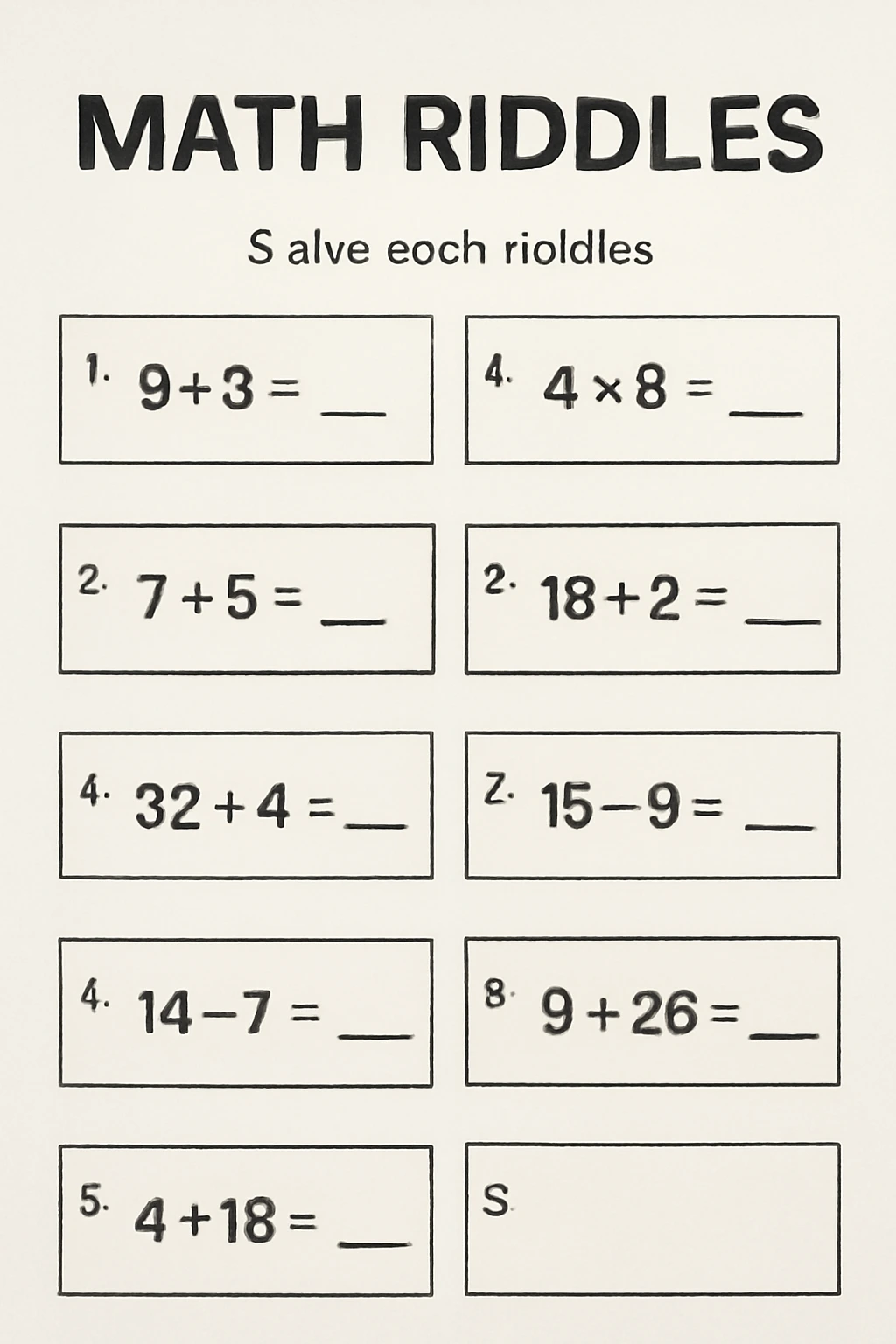
Math can often feel like a chore for kids, but it doesn’t have to be that way. Math riddle sheets combine the best of both worlds: they make math fun while reinforcing important math concepts. These worksheets feature a blend of math problems and puzzles, allowing children to engage with numbers in a creative and enjoyable way. Whether it’s simple arithmetic or more complex geometry, math riddle sheets help improve problem-solving skills, boost critical thinking, and make learning math feel like a game. In this article, we’ll explore the benefits of math riddle sheets, how to use them effectively, and where to find them.
Quick Answer
Math riddle sheets are worksheets that pair math problems with puzzles or riddles. Solving these problems helps uncover answers or solve a larger puzzle, making math more engaging for kids and promoting critical thinking and problem-solving skills.
Table of Contents
- Riddle Worksheet Basics — What Are Math Riddle Sheets?
- Why Teachers and Parents Love Math Riddle Sheets
- Typical Age/Grade Ranges for Printable Riddle Worksheets
- Core Math Topics Covered by Riddle Sheets
- How Math Riddle Sheets Boost Problem-Solving and Critical Thinking
- Printable vs Interactive Riddle Worksheets — Pros & Cons
- Free Sources for Math Riddle Sheets (K–6)
- Designing Your Own Custom Math Riddle Sheet
- Tips for Choosing the Right Riddle Sheets by Age/Skill Level
- How to Introduce Riddle Sheets to Your Child or Class
- Balancing Fun and Learning: Avoiding Frustration
- Using Riddle Sheets as Homework Supplements
- When Riddle Sheets Are Not Enough — What Else to Pair With Them
- Common Mistakes to Avoid When Using Riddle Worksheets
- Conclusion
Riddle Worksheet Basics — What Are Math Riddle Sheets?
Math riddle sheets are worksheets that incorporate math problems alongside riddles or puzzles. These types of worksheets challenge kids to solve math problems and then use their answers to reveal hidden messages, complete puzzles, or find answers to tricky riddles. This approach turns math practice into a more interactive, problem-solving experience.
These worksheets often cover a wide variety of math topics, from basic addition and subtraction to more advanced subjects like fractions, multiplication, division, and geometry. The key benefit of math riddle sheets is that they encourage children to think critically, apply their knowledge in new ways, and develop a deeper understanding of math concepts.
Why Teachers and Parents Love Math Riddle Sheets
Math riddle sheets are highly appreciated by both teachers and parents for several reasons. First, they make math more enjoyable by transforming it into a fun, interactive game. This can be particularly useful for children who struggle with traditional math lessons or find math intimidating. By solving riddles, children start to associate math with enjoyment rather than stress.
Moreover, math riddles foster important cognitive skills such as problem-solving, logical reasoning, and critical thinking. These are the skills that will help kids excel not only in math but in other areas of life as well. Teachers and parents often use these sheets to reinforce learning, giving children a break from the usual routine while still supporting their education.
Typical Age/Grade Ranges for Printable Riddle Worksheets
Math riddle sheets are most commonly used for children in elementary school (grades 1–6), but the difficulty can be adjusted to suit a range of ages and skill levels. Younger children (grades 1–2) typically work with basic arithmetic problems, such as simple addition and subtraction, while older children (grades 3–6) may tackle more complex topics like fractions, multiplication, division, and basic geometry.
For middle school students, the difficulty of the riddles can be increased even further, incorporating more advanced math concepts and multi-step problems. Adjusting the difficulty to fit the child’s level ensures that the worksheets remain both challenging and fun.
Core Math Topics Covered by Riddle Sheets
Math riddle sheets cover a wide range of math topics, allowing kids to practice multiple concepts at once. Common topics include:
- Basic arithmetic: addition, subtraction, multiplication, division
- Fractions and decimals: understanding parts of a whole and performing operations with fractions
- Geometry: identifying shapes, calculating area, perimeter, and volume
- Unit conversions: converting between different units of measurement
- Word problems: applying math skills to real-life situations
- Logic puzzles: strengthening reasoning and critical thinking skills
These varied topics help children build a broad understanding of math while keeping the learning process fun and engaging.
How Math Riddle Sheets Boost Problem-Solving and Critical Thinking
Math riddle sheets promote problem-solving by requiring students to engage in multiple steps to find the answer. Unlike simple math problems, riddles and puzzles encourage children to use reasoning and think outside the box. This process helps build critical thinking skills, as students must consider various possibilities, analyze their options, and test different solutions.
In addition, solving riddles helps children develop perseverance. Since many puzzles require multiple steps to solve, kids learn to work through challenges and not give up after a single failure. This persistence builds confidence and helps kids feel proud of their accomplishments, motivating them to tackle even more challenging problems.
Printable vs Interactive Riddle Worksheets — Pros & Cons
Printable Math Riddle Worksheets
- Easy to print and distribute in class or at home
- Great for offline learning, especially for students who prefer tactile learning
- No need for internet or devices, making them ideal for situations where digital access is limited
Interactive Math Riddle Worksheets
- Visually engaging with interactive elements, such as animations and feedback
- Can provide instant feedback and track progress, which is helpful for both kids and parents
- Often more motivating with colorful designs and sound effects
- Ideal for students who enjoy digital learning and need more engagement
Both formats have their benefits, and using a combination of printable and interactive worksheets can provide a balanced learning experience.
Free Sources for Math Riddle Sheets (K–6)
There are many free resources available online for printable math riddle worksheets. Some popular websites offering free worksheets include:
- Super Teacher Worksheets — Offers a variety of math riddles for different skill levels.
- Math Salamanders — Provides free printable math riddle worksheets, ranging from simple to complex.
- SplashLearn — Features a collection of fun math riddles designed to reinforce basic math skills.
These websites offer valuable resources for parents and teachers looking for free, quality math worksheets.
Designing Your Own Custom Math Riddle Sheet
If you can’t find the exact riddle sheet you need, designing your own is easy:
- Choose a math topic that aligns with your child’s current learning objectives.
- Create a set of math problems related to that topic.
- Develop a riddle or puzzle that the answers to the problems will help solve.
- Add an answer key to help the student check their work.
Custom riddle sheets allow you to target specific learning goals and create an engaging math experience for your child.
Tips for Choosing the Right Riddle Sheets by Age/Skill Level
- Grades 1–2: Focus on simple addition, subtraction, and visual aids for younger children.
- Grades 3–4: Introduce multiplication, division, fractions, and simple geometry.
- Grades 5–6: Use more advanced riddles with multiple steps, basic algebra, and geometry puzzles.
- Middle School: Increase the difficulty with more complex topics such as pre-algebra and logic puzzles.
Adjusting the difficulty based on the child’s age and skill level helps keep them challenged and engaged.
How to Introduce Riddle Sheets to Your Child or Class
When introducing math riddle worksheets, make them feel like a fun challenge rather than homework. Praise children for their effort, and encourage them to talk through their reasoning to help reinforce learning. Offering support when necessary ensures that kids don’t feel frustrated when they encounter difficult problems.
Balancing Fun and Learning: Avoiding Frustration
Start with simpler puzzles and gradually increase the difficulty. Give kids breaks between more challenging riddles to maintain focus and avoid frustration. Celebrate progress and help them develop a positive relationship with math.
Using Riddle Sheets as Homework Supplements
Math riddle sheets should complement traditional math homework, providing variety and extra practice. Use them as an enrichment tool to reinforce what children have learned in class, helping them retain and apply the knowledge.
When Riddle Sheets Are Not Enough — What Else to Pair With Them
While math riddle sheets are a great tool, they should be paired with other learning methods, such as textbooks, real-world math applications, and visual aids. This combination ensures that children grasp fundamental concepts while developing a deeper understanding of how math is used in everyday life.
Common Mistakes to Avoid When Using Riddle Worksheets
- Choosing too difficult riddles — avoid frustrating children with problems that are too advanced.
- Overusing riddles — balance riddles with traditional math exercises to reinforce foundational skills.
- Skipping answer keys — always provide an answer key so children can check their work and learn from their mistakes.
Conclusion
Math riddle sheets provide a fun and engaging way for children to practice math. They help foster problem-solving skills, critical thinking, and a positive attitude toward learning. By using these worksheets as a supplement to traditional lessons, parents and teachers can make math more exciting while ensuring kids develop the necessary skills for success.

Shel Silverstein was a multi-talented poet, songwriter, and children’s author from the USA. His playful poems often felt like riddles in disguise, blending humor with deep meaning, making him a timeless favorite for puzzle and word lovers.