
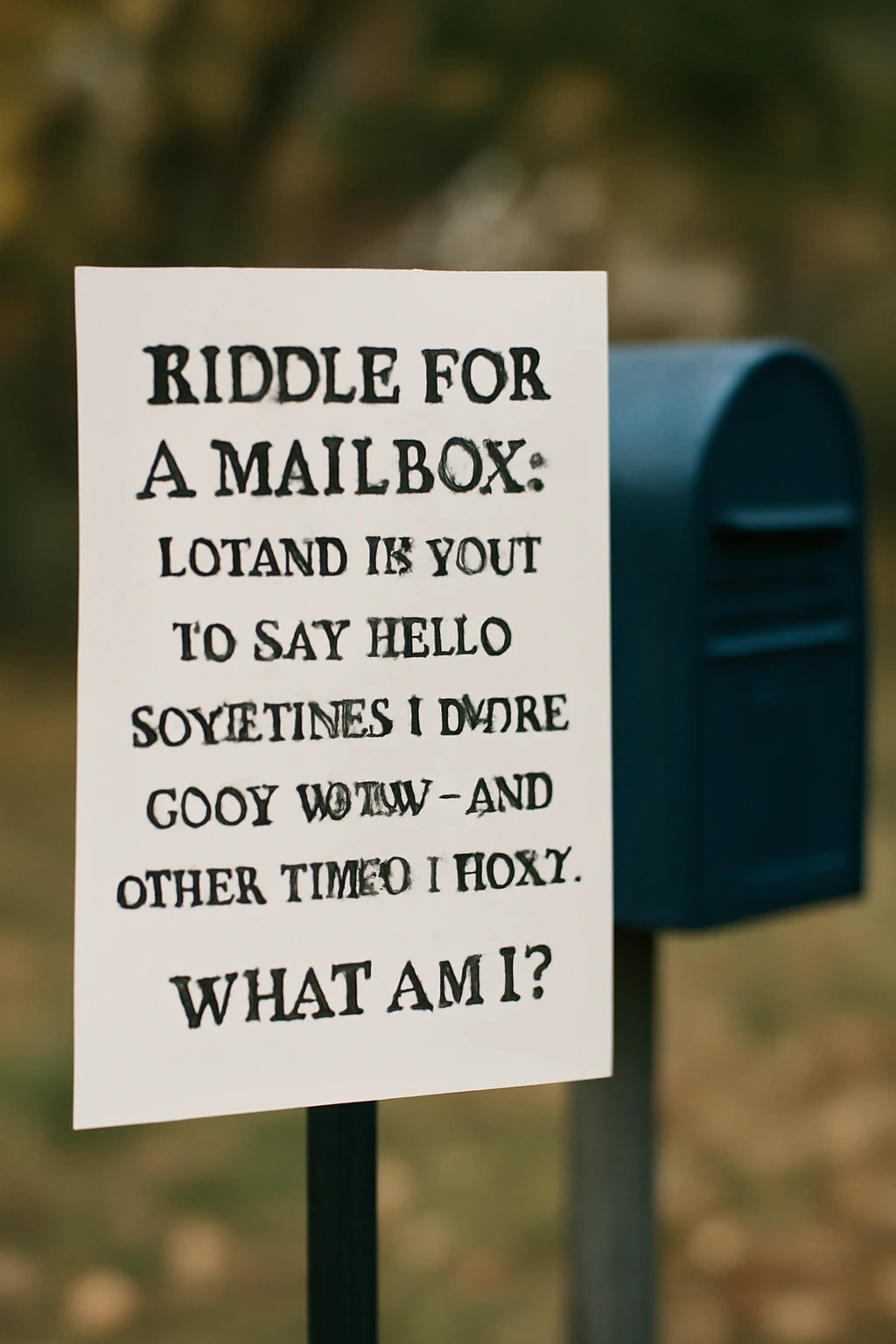
Whether you’re planning a family game night, a classroom activity, a scavenger hunt, or just looking for a fun brain‑teaser, a riddle for a mailbox can add surprise and smiles. Mailbox riddles tap into something simple and familiar — that little box by your driveway holding letters, packages, and occasionally forgotten bills. In this article, you’ll find ready‑to‑use riddles, rhyming versions, scavenger‑hunt clues, and tips for writing your own — all based on everyday mailbox ideas.
Quick Answer
A “riddle for a mailbox” is a short brain‑teaser whose answer is “mailbox.” These riddles play on familiar mailbox traits — such as a slot, a flag, or standing outside a house — and phrase them in clever or poetic ways to make the solver think before the answer clicks.
Table of Contents
• Why Mailbox Riddles Are Great
• What Makes a Good Mailbox Riddle
• Easy Mailbox Riddles for Kids
• Classic One‑Line Mailbox Riddles (All Ages)
• Rhyming Mailbox Riddles You Can Use
• Slightly Tricky Mailbox Riddles (Teens & Adults)
• Scavenger‑Hunt Style Mailbox Riddles & Clues
• Thematic Variants: Holiday, Romantic, Funny Riddles
• How to Write Your Own Mailbox Riddle
• Common Mistakes to Avoid in Riddle Writing
• Using Mailbox Riddles in Games & Activities
• Why Simplicity Often Works Better Than Complexity
• What to Consider When Sharing With Kids and Families
• Printable & Shareable Formats for Mailbox Riddles
• FAQs
• Conclusion: The Enduring Charm of Mailbox Riddles
Why Mailbox Riddles Are Great
A mailbox is a familiar, everyday object — nearly everyone knows what it looks like and what it does. This familiarity makes mailbox riddles accessible to a wide audience. They’re quick puzzles that are easy to read and often simple to guess. Because they play on common experiences, mailbox riddles work well for kids, families, and mixed‑age groups. They offer that satisfying “aha!” moment that makes them enjoyable for everyone.
What Makes a Good Mailbox Riddle
A good mailbox riddle gives enough clues to hint at “mailbox” without giving it away too easily. It often mentions a few unique features — like a slot, a flag, or its location outdoors — but keeps the wording playful or slightly indirect. Clever rhymes or metaphors can also add fun. The key is to find the balance between clarity and mystery, so the solver gets that moment of realization when they figure it out.
Easy Mailbox Riddles for Kids
Here are some simple and fun riddles that are perfect for younger kids or beginners:
• What holds letters but never speaks?
•Red flag but never flies.
• What gets opened every day but doesn’t move?
• Which box waits outside your house for a message?
• What stands outside your home all day, waiting for letters?
Classic One‑Line Mailbox Riddles (All Ages)
These riddles are straightforward and work across age groups:
• I open my mouth but never speak; I hold your mail when postmen sneak. What am I?
• I stand alone by the road, collecting tales from near and far. Who am I?
• I have a door but no house; I take letters but never read them. What am I?
• I’m full of papers but never type or read. What am I?
• I stand outside, rain or shine, yet I never walk a step. What am I?
Rhyming Mailbox Riddles You Can Use
Adding rhyme to your riddles makes them more playful and fun:
• “I stand outside your gate all day, accepting letters sent your way. What am I?”
• “I have a slot but don’t type keys — I store your mail with silent ease.”
• “I never walk, yet stand with grace; I hold your post until you take your place.”
Slightly Tricky Mailbox Riddles (Teens & Adults)
For older kids or adults, a little twist in the wording can make the riddle more challenging:
• I’m a box with hundreds of letters, yet I’ve never spoken one word. What am I?
• I stand at the edge of your path, guarding secrets until you return. Who am I?
• I never walk, I never talk, yet I carry your messages on lock. What am I?
• I raise a flag when news arrives, but I myself don’t deliver the mail. What am I?
• I eat paper every day, but I never get full. What am I?
Scavenger‑Hunt Style Mailbox Riddles & Clues
Mailbox riddles are also great for scavenger hunts or treasure‑hunt games. Here are some ideas:
• I wait outside but I’m not alive; your next clue lies where letters arrive.
• I may have a slot, a flag, or a door — find me near the road to spot the score.
• I stand still though messages come and go — your clue resides where envelopes flow.
• Follow the driveway’s edge, check near the curb — that’s where your mailbox hides the next verb.
• The first stop for letters you send afar — I mark the start (or end) of your mail‑star.
Thematic Variants: Holiday, Romantic, Funny Riddles
Mailbox riddles can take on a special flair depending on the context:
• Holiday card mailbox: “I’m filled with cheer around each year — open me for mail from far or near.”
• Love‑letter version: “I hold your heart’s written plea, though I won’t return to thee. What am I?”
• Funny version: “I’m always full of bills and ads — I’m your least‑favorite box for glad.”
• Mystery twist: describe the mailbox as a “silent vault,” “paper graveyard,” or “letter’s resting spot.”
How to Write Your Own Mailbox Riddle
If you want to create your own mailbox riddles, here’s a simple guide:
• List 2–3 key traits of a mailbox (slot, flag, outdoors, holds letters).
• Phrase clues in poetic or playful language.
• Avoid overly vague descriptions or contradictory hints.
• Decide on the target age group — simpler riddles for kids, more abstract ones for teens/adults.
• Test the riddle on someone who doesn’t know the answer — adjust if it’s too easy or too hard.
Common Mistakes to Avoid in Riddle Writing
Here are a few things to watch out for when creating your riddles:
• Giving away the answer too easily (e.g., “I hold mail — I am a mailbox”).
• Using obscure or overly poetic language that confuses the solver.
• Overloading with too many clues, making the answer too obvious.
• Making the answer ambiguous (e.g., could be “post office,” “mail slot,” or “mailbag”).
Using Mailbox Riddles in Games & Activities
Mailbox riddles can make any game or gathering more fun:
• Kids’ birthday parties or family gatherings — quick fun between activities.
• Classroom games — a way to teach vocabulary or encourage problem‑solving.
• Scavenger or treasure hunts — riddles pointing to locations or clues.
• Holiday events — hide clues for gifts or cards using themed mailbox riddles.
Why Simplicity Often Works Better Than Complexity
Because the goal is fun and surprise, simple riddles are often the best. Over‑complex riddles can frustrate or bore solvers. A clean, clear riddle creates that satisfying “aha!” moment that makes the puzzle memorable.
What to Consider When Sharing With Kids and Families
When sharing riddles with children or mixed‑age groups, consider these tips:
• Keep the language clear and simple.
• Avoid double meanings or overly abstract metaphors.
• Make sure the riddle is fair — don’t rely on obscure wordplay.
• Ensure that the answer is unambiguous before sharing it.
Printable & Shareable Formats for Mailbox Riddles
To make the riddles easy to share:
• Write them on index cards or slip them into envelopes for physical games.
• Share them digitally through text or email for virtual scavenger hunts.
• Add pictures or drawings of a mailbox for visual clues.
FAQs
What is a good riddle about a mailbox?
A simple one is: “What holds letters but never speaks?” The answer: mailbox.
What has a red flag but never flies?
That’s another classic — the mailbox, which uses a flag to signal mail arrival.
What gets opened every day but doesn’t move?
A mailbox — or sometimes a mailbox slot — gets opened and closed even though it stays in place.
Can mailbox riddles be used for scavenger hunts?
Yes — many riddles referencing location, slot, and mail delivery can serve as clues in scavenger‑hunt games.
How do I make a mailbox riddle fun for kids and adults alike?
Keep clues simple, avoid ambiguous vocabulary, and optionally add rhyme or gentle humor for charm.
Conclusion
Mailbox riddles are simple, shareable, and endlessly fun. Whether for kids, parties, family gatherings, or casual laughs, a good mailbox riddle can deliver more than just mail — it can deliver joy and that satisfying moment of discovery.

Shel Silverstein was a multi-talented poet, songwriter, and children’s author from the USA. His playful poems often felt like riddles in disguise, blending humor with deep meaning, making him a timeless favorite for puzzle and word lovers.