
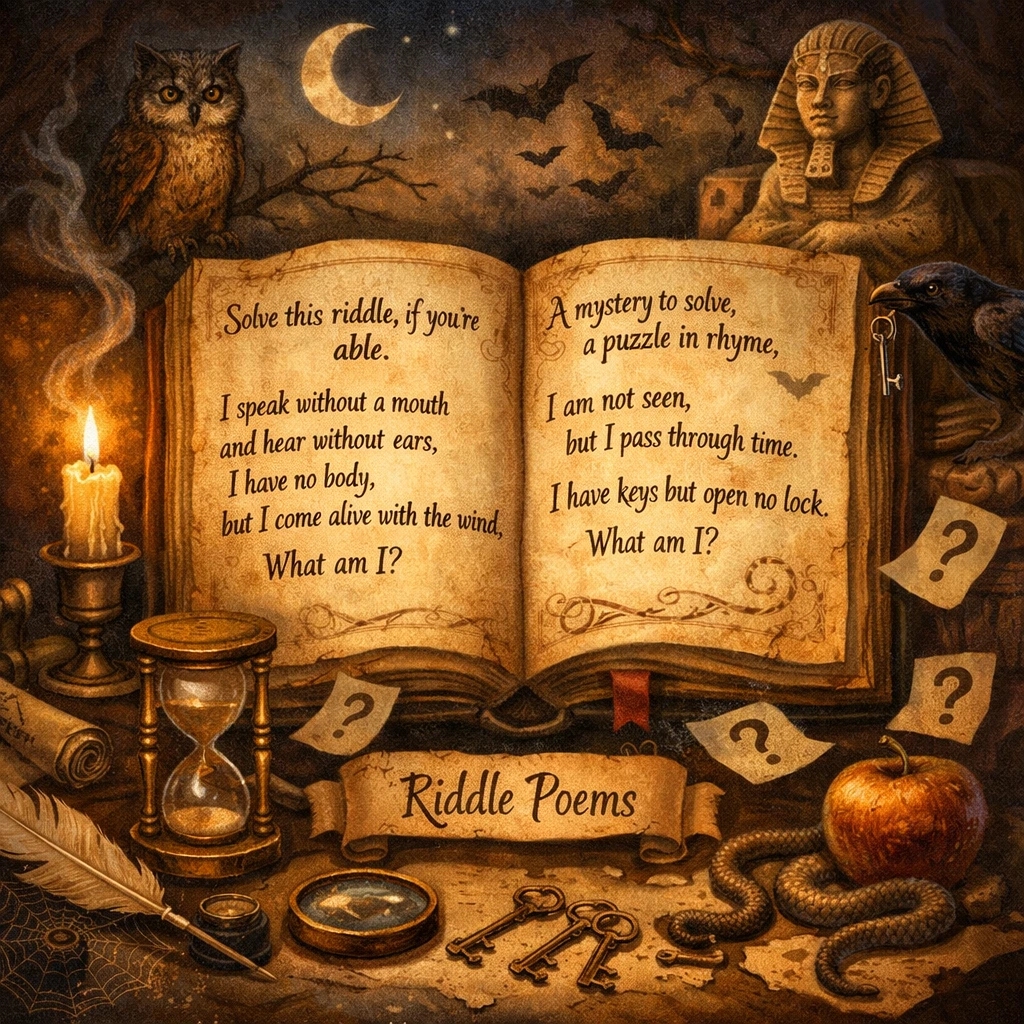
Riddle poems are one of the most captivating forms of poetry, blending the beauty of language with the excitement of problem-solving. Instead of stating ideas directly, these poems invite readers to decode clues, interpret metaphors, and uncover hidden meanings. They challenge the mind while delighting the imagination, making poetry feel interactive rather than passive.
From ancient traditions to modern classrooms, riddle poems have endured because they engage readers of all ages. Whether you’re a student discovering poetry, a teacher looking for creative tools, or a writer seeking a fresh challenge, riddle poems offer a unique way to experience verse. This complete guide explores everything you need to know about riddle poems, from their origins to writing your own.
Quick Answer
Riddle poems are poetic puzzles that describe a person, object, idea, or experience through indirect clues, imagery, and metaphor, challenging readers to guess the hidden answer.
TL;DR
• Riddle poems combine poetry and puzzles
• They describe without naming the answer
• Imagery and metaphor are essential
• Readers solve the poem’s hidden meaning
• Writers use clues instead of explanations
What Are Riddle Poems?
Riddle poems are verses written as mysteries. Rather than explaining their subject openly, they rely on carefully chosen clues that guide the reader toward a solution. The answer is never stated outright, which makes the reader an active participant in the poem.
These poems often use figurative language to disguise familiar objects or ideas. A candle might become “a body that melts while giving light,” or time may be portrayed as “something that runs yet never moves.” The pleasure comes from recognition and discovery.
Riddle poems can be short and playful or layered and complex. What defines them isn’t length or rhyme, but the central goal: inviting curiosity and rewarding insight.
Key Characteristics of Riddle Poems
Riddle poems share several defining traits that set them apart from other poetic forms. Understanding these elements helps both readers and writers appreciate their structure.
They rely heavily on metaphor, symbolism, and sensory detail. Each line offers a clue, but no single clue gives everything away. The poem must strike a balance between mystery and fairness, offering enough information to be solved without making the answer obvious.
Unlike straightforward descriptive poems, riddle poems thrive on indirection. They encourage readers to reread, rethink, and reinterpret words until the solution becomes clear.
A Brief History of Riddle Poetry
Riddle poems have deep historical roots. Some of the earliest known examples appear in ancient civilizations, where riddles were used as tests of wisdom and intelligence. In medieval Europe, riddle verse flourished in Anglo-Saxon manuscripts and Norse traditions.
These early riddle poems often explored everyday objects, natural forces, and human experiences. They were shared orally, passed down through generations, and used in storytelling and teaching.
Over time, riddle poems evolved but never disappeared. Today, they appear in children’s literature, classrooms, puzzle books, and creative writing communities, proving their timeless appeal.
Why Riddle Poems Are So Popular
Riddle poems remain popular because they engage both emotion and intellect. They make readers pause, think, and interact with language instead of simply consuming it.
They are especially effective for young readers, helping build vocabulary, critical thinking, and creative confidence. For adults, riddle poems offer clever wordplay and mental challenge, often revealing new ways of seeing ordinary things.
Their adaptability also adds to their appeal. Riddle poems can be humorous, serious, philosophical, or whimsical, depending on the writer’s intent.
Types of Riddle Poems
Riddle poems come in many forms, each with its own flavor. Some focus on objects, such as tools, foods, or natural elements. Others explore abstract ideas like time, emotions, or dreams.
There are humorous riddle poems designed to entertain, and more complex ones meant to provoke reflection. Some follow strict rhyme schemes, while others use free verse to let imagery lead the way.
This flexibility allows writers to experiment and readers to enjoy a wide range of styles within the same poetic tradition.
Common Themes in Riddle Poems
Certain themes appear frequently in riddle poems because they lend themselves well to metaphor. Nature is a favorite subject, with riddles about rivers, mountains, shadows, and stars.
Everyday objects are also common, transformed through imaginative descriptions that hide their identity. Human experiences, such as sleep, fear, or love, often appear in more advanced riddle poems.
By disguising the familiar, riddle poems encourage readers to see the world from new angles.
How Riddle Poems Work
A riddle poem works by layering clues. Each line contributes a piece of information, often through figurative language rather than literal description. The reader gathers these clues and forms hypotheses about the answer.
Good riddle poems avoid misleading tricks. While they may surprise the reader, they remain logically consistent. Once solved, the answer should feel satisfying and inevitable.
This process creates a sense of discovery that makes riddle poems memorable and enjoyable.
How to Write a Riddle Poem
Writing a riddle poem starts with choosing an answer. Decide what you want the reader to guess, then list its traits, behaviors, and associations. From there, think of metaphors and images that suggest those traits without naming them.
Focus on clarity and restraint. Each line should add value without giving away too much. Reading your poem aloud helps refine rhythm and flow.
Testing your riddle poem on others is essential. If no one can solve it, it may be too vague. If everyone guesses instantly, it may need more mystery.
Tips for Writing Better Riddle Poems
Strong riddle poems use vivid language and precise imagery. Avoid generic descriptions and aim for sensory details that engage sight, sound, or touch.
Rewriting is key. Many successful riddle poems go through several drafts before achieving the right balance. Reading classic and modern examples can also sharpen your instincts.
Most importantly, have fun with the process. Riddle poems thrive on playfulness and curiosity.
Riddle Poems in Education
Teachers often use riddle poems to make learning interactive. They support reading comprehension, vocabulary growth, and creative thinking.
Students enjoy solving riddles and writing their own, which builds confidence with language. Riddle poems also work well across subjects, connecting poetry with science, history, and problem-solving.
Because they encourage discussion and interpretation, riddle poems are powerful classroom tools.
Riddle Poems for All Ages
One of the strengths of riddle poems is their universal appeal. Children enjoy simple riddles with clear clues, while adults appreciate layered meanings and clever wordplay.
Families often share riddle poems as games, reading aloud and guessing together. This shared experience strengthens language skills and curiosity across generations.
Riddle poems prove that poetry doesn’t have to be intimidating to be meaningful.
How Riddle Poems Differ From Regular Riddles
While riddles and riddle poems share a goal, their execution differs. Traditional riddles are usually brief questions or statements. Riddle poems, however, emphasize rhythm, imagery, and poetic craft.
The poetic form allows for deeper emotion and artistic expression. This makes riddle poems not just puzzles, but works of art.
Modern Uses of Riddle Poems
Today, riddle poems appear in books, classrooms, social media, and creative writing spaces. Writers use them for contests, games, and personal expression.
They are also popular in educational publishing and children’s media, where learning and entertainment overlap.
As attention spans shorten, the interactive nature of riddle poems helps poetry remain engaging and relevant.
FAQs
What is the main purpose of a riddle poem?
The purpose of a riddle poem is to entertain and challenge readers by hiding an answer within poetic clues.
Do riddle poems have to rhyme?
No. Riddle poems can rhyme or use free verse, as long as they present clues creatively.
Are riddle poems only for children?
Not at all. Riddle poems can be written for any age, from playful to highly complex.
How long should a riddle poem be?
There’s no fixed length. Some are just a few lines, while others are more detailed.
Can abstract ideas be used in riddle poems?
Yes. Many riddle poems explore abstract concepts like time, emotions, or ideas.
Why are riddle poems used in schools?
They build vocabulary, comprehension, and critical thinking in an engaging way.
Conclusion
Riddle poems stand at the crossroads of poetry and play. They transform language into a game of insight, inviting readers to slow down, think deeply, and enjoy discovery. Whether you’re reading them for fun, teaching them in a classroom, or writing your own, riddle poems offer a timeless and rewarding experience that proves poetry can be both clever and captivating.

Shel Silverstein was a multi-talented poet, songwriter, and children’s author from the USA. His playful poems often felt like riddles in disguise, blending humor with deep meaning, making him a timeless favorite for puzzle and word lovers.