
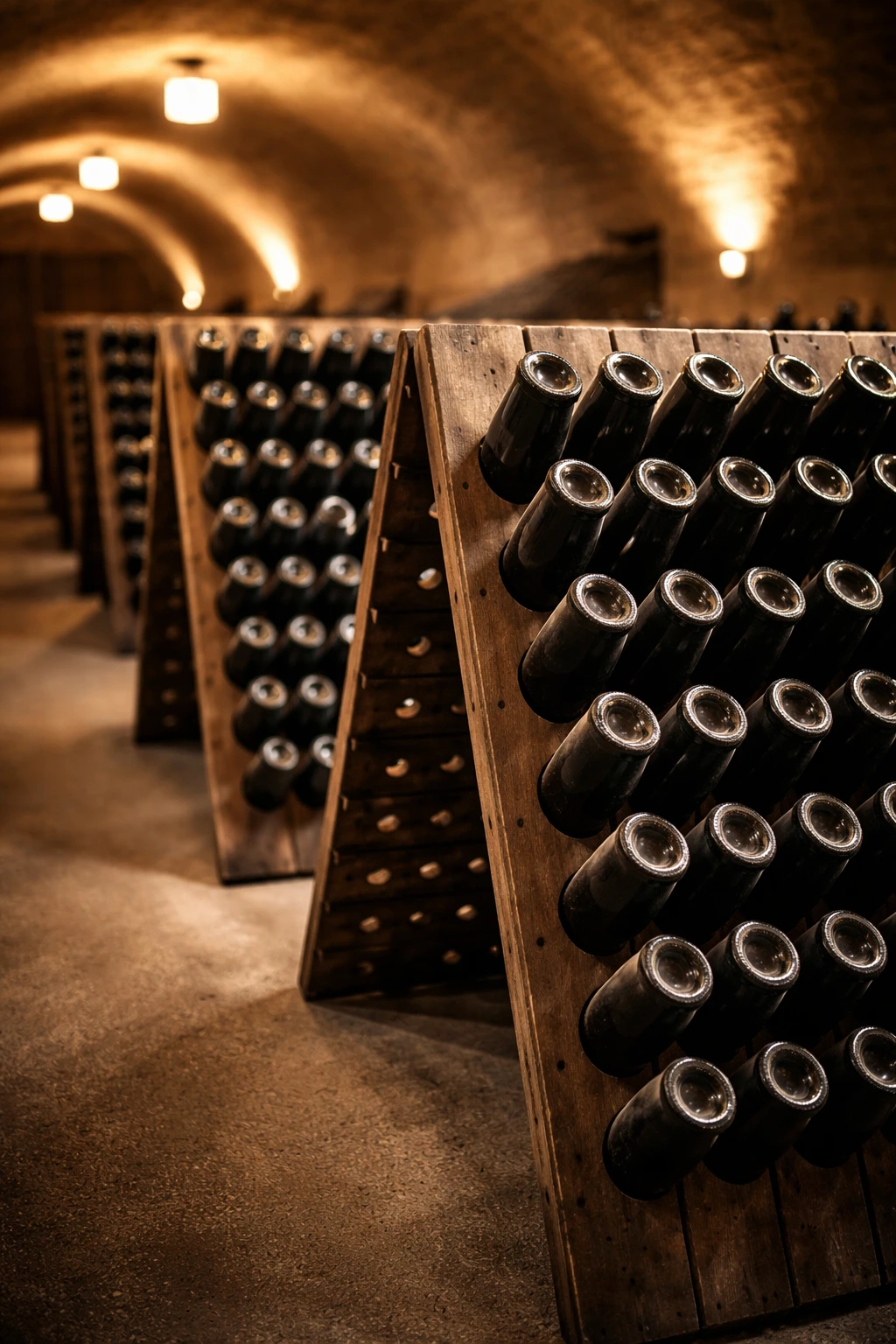
Every glass of Champagne promises clarity, balance, and fine bubbles. However, that visual perfection doesn’t happen by chance. Behind the scenes, a precise and time-honored technique plays a vital role in shaping the final wine. Riddling champagne is the process that quietly transforms cloudy bottles into refined sparkling wine.
Although often overlooked, riddling stands at the heart of traditional Champagne production. Without it, sediment would remain suspended, dulling both appearance and texture. As a result, this guide explores how riddling works, why it matters, and how it continues to define quality Champagne today.
Quick Answer
Riddling champagne is the gradual turning and tilting of bottles to collect yeast sediment in the neck, allowing Champagne to become clear and ready for disgorgement.
TL;DR
• Riddling gathers yeast sediment
• It ensures Champagne clarity
• Bottles are slowly rotated
• Methods can be manual or automated
• Essential to traditional sparkling wine
What Riddling Means in Champagne Making
At its core, riddling—also known as remuage—is a controlled movement process. Instead of disturbing the wine, bottles are gently rotated while gradually angled downward. Over time, gravity guides sediment toward the bottle neck.
As a result, Champagne becomes visually brilliant without filtration. This careful approach protects flavor while maintaining pressure and structure. Ultimately, riddling reflects patience and precision rather than speed.
• Known as remuage in French
• Performed after second fermentation
• Uses gravity instead of filtering
• Maintains sealed bottles
• Preserves wine structure
• Prevents cloudiness
• Protects carbonation
• Requires consistency
• Demands careful timing
• Enhances presentation
• Signals quality production
• Defines traditional methods
Why Riddling Champagne Is Necessary
After fermentation, yeast cells remain suspended in the bottle. While these lees initially add complexity, they must eventually be removed. Without riddling, Champagne would pour hazy and feel coarse on the palate.
Therefore, riddling provides a clean solution that avoids opening the bottle early. By doing so, it preserves both elegance and freshness.
• Eliminates unwanted sediment
• Preserves visual clarity
• Maintains smooth texture
• Protects aroma balance
• Prevents bitter flavors
• Keeps wine under pressure
• Supports long aging
• Avoids filtration damage
• Ensures professional finish
• Improves consistency
• Enhances consumer experience
• Meets quality expectations
How the Riddling Process Works Step by Step
Initially, bottles rest horizontally after fermentation. Over days or weeks, they are turned slightly and tilted further downward. Each movement is small, intentional, and precise.
Eventually, every bottle reaches a fully inverted position. At that point, all sediment rests neatly in the neck, ready for removal.
• Bottles begin lying flat
• Rotated incrementally
• Tilt increases gradually
• Sediment slides downward
• Wine remains calm
• Movements avoid shaking
• Cellar temperature stays stable
• Pressure remains sealed
• Process follows strict timing
• Ends fully inverted
• Sediment fully collected
• Bottles prepared for disgorgement
Traditional Hand Riddling Explained
Historically, riddling was done entirely by hand. Skilled workers turned each bottle individually, often handling thousands per day. Their experience guided every motion.
Even today, some producers continue this method. Although time-intensive, hand riddling allows precise control and honors tradition.
• Performed by trained riddlers
• Uses wooden pupitres
• Requires daily attention
• Demands physical endurance
• Allows subtle adjustments
• Suited for small batches
• Valued for craftsmanship
• Common in prestige cuvées
• Labor-intensive process
• Rooted in tradition
• Limited production scale
• Symbol of authenticity
Modern Riddling With Gyropalettes
Over time, technology transformed riddling. Automated gyropalettes now replicate traditional movements on a larger scale. These machines handle hundreds of bottles simultaneously.
As a result, producers gain efficiency without sacrificing quality. Consequently, automation has become the industry standard.
• Fully automated systems
• Handle large volumes
• Mimic hand movements
• Reduce riddling time
• Improve consistency
• Lower labor demands
• Widely adopted today
• Programmable rotations
• Maintain wine integrity
• Cost-effective solution
• Scalable production
• Reliable results
The History of Riddling Champagne
Before riddling existed, Champagne was often cloudy. Consumers accepted sediment as unavoidable. However, innovation soon changed expectations.
During the early 1800s, refined riddling techniques transformed Champagne into a clear, export-ready wine.
• Developed in early 19th century
• Solved clarity issues
• Improved global appeal
• Enabled commercial growth
• Refined production standards
• Influenced sparkling wines worldwide
• Elevated Champagne reputation
• Encouraged innovation
• Defined premium expectations
• Preserved effervescence
• Supported aging potential
• Shaped modern methods
Madame Clicquot’s Role in Riddling
One pivotal figure advanced riddling dramatically. Madame Barbe-Nicole Clicquot refined bottle rotation to remove sediment efficiently without losing bubbles.
Thanks to her innovation, Champagne gained consistency and elegance. Her legacy still guides producers today.
• Pioneered refined riddling
• Improved sediment control
• Preserved carbonation
• Enhanced clarity
• Advanced production efficiency
• Strengthened Champagne identity
• Supported global expansion
• Influenced modern practices
• Encouraged technical precision
• Cemented historical legacy
• Defined excellence
• Inspired innovation
Riddling Racks and Equipment
Traditional riddling relies on wooden racks called pupitres. These racks hold bottles at precise angles while allowing easy rotation.
Even now, many cellars use these racks alongside modern equipment.
• Wooden pupitres design
• Angled bottle placement
• Stable cellar setup
• Durable materials
• Enables gradual tilting
• Used for hand riddling
• Space-efficient layout
• Simple construction
• Long-lasting tools
• Traditional craftsmanship
• Functional elegance
• Historic symbolism
How Long Riddling Takes
The duration of riddling depends on the chosen method. Hand riddling takes longer, while machines accelerate the timeline.
Nevertheless, producers never rush this stage.
• Hand riddling lasts weeks
• Machine riddling takes days
• Depends on wine style
• Influenced by bottle size
• Adjusted for sediment volume
• Coordinated with aging plans
• Controlled cellar conditions
• Precision over speed
• Carefully scheduled
• Impacts final clarity
• Planned in advance
• Integrated into workflow
Riddling vs Disgorgement
Although closely linked, riddling and disgorgement serve different purposes. Riddling gathers sediment, while disgorgement removes it.
Together, they complete the clarification process.
• Riddling moves sediment
• Disgorgement removes sediment
• Separate production stages
• Follow strict order
• Both preserve bubbles
• Both protect clarity
• Require precision
• Work sequentially
• Essential partnership
• Define final quality
• Maintain elegance
• Complete production
Does Riddling Affect Flavor
While riddling doesn’t change flavor directly, it protects what already exists. Gentle movement prevents oxidation and disturbance.
Consequently, the wine tastes balanced and refined.
• Preserves aroma profile
• Maintains texture
• Prevents bitterness
• Avoids oxidation
• Protects freshness
• Supports aging character
• Balances yeast influence
• Maintains mouthfeel
• Ensures consistency
• Enhances elegance
• Safeguards complexity
• Improves drinkability
Riddling in Other Sparkling Wines
Champagne isn’t alone in using riddling. Other bottle-fermented sparkling wines rely on the same technique.
Therefore, riddling represents a global standard for quality.
• Used beyond Champagne
• Common in traditional methods
• Required for bottle fermentation
• Found worldwide
• Supports clarity standards
• Preserves fine bubbles
• Signals premium quality
• Reflects craftsmanship
• Excludes tank methods
• Shared heritage
• Global application
• Recognized benchmark
Is Riddling Still Relevant Today
Despite modern shortcuts, riddling remains essential. Consumers expect clarity and authenticity, especially in premium wines.
For that reason, riddling continues to define excellence.
• Still widely practiced
• Essential to tradition
• Supported by automation
• Valued by producers
• Expected by consumers
• Protects heritage
• Ensures quality
• Supports premium perception
• Blends old and new
• Future-proof process
• Industry cornerstone
• Timeless relevance
FAQs
What is riddling champagne in simple terms?
Riddling champagne is the process of turning bottles so yeast sediment collects in one place for removal.
Is riddling still done by hand?
Yes, although most producers use machines, some still hand-riddle premium wines.
Does riddling change Champagne’s taste?
No, it protects existing flavors by keeping the wine undisturbed.
How long does riddling usually take?
It ranges from several days with machines to several weeks by hand.
Do all sparkling wines use riddling?
Only wines made with bottle fermentation require riddling.
Why is riddling important for clarity?
It gathers sediment neatly, allowing Champagne to pour crystal clear.
Conclusion
Riddling champagne is a quiet but indispensable craft that transforms fermented wine into a clear, elegant sparkling experience. By combining tradition, precision, and modern innovation, riddling protects quality while honoring Champagne’s heritage. The next time you raise a glass, you’ll understand the careful process that brought those fine bubbles to life.

Christopher Adams is a puzzle enthusiast and riddle creator from the USA. He is known for mixing humor with logic, producing riddles that make readers laugh while they think.