
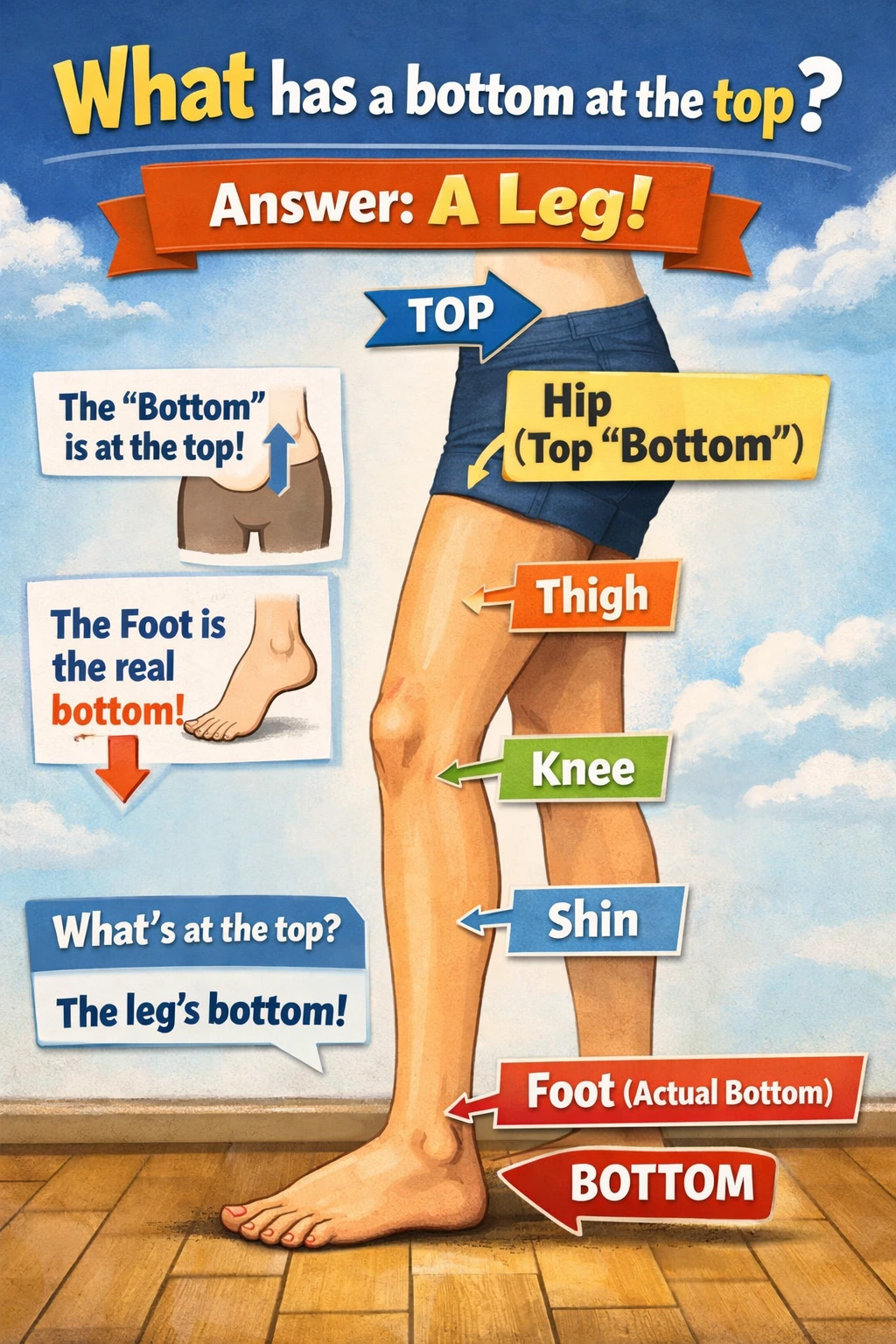
Riddles have a special way of making simple ideas feel confusing. One classic example is the what has a bottom at the top riddle, a question that has puzzled kids and adults for generations. At first glance, it sounds impossible. Still, the answer is surprisingly simple once you see the trick.
This guide breaks down the meaning, answer, and reasoning in plain English. You’ll also find variations, explanations, and tips for using this riddle for fun or learning.
Quick Answer
The what has a bottom at the top riddle is answered by a leg.
Your leg’s “bottom” is at the top, near your hip.
TL;DR
• The answer is a leg
• It uses wordplay, not logic
• Simple once explained
• Commonly used with kids
• Great brain teaser
What Does “What Has a Bottom at the Top” Mean
This riddle plays with everyday language meanings.
It sounds confusing because “bottom” usually suggests something lower.
• Focuses on body part naming
• Uses common words differently
• Sounds impossible at first
• Designed to mislead gently
• Relies on perspective shift
• Short and memorable phrasing
• Popular in classrooms
• Often shared verbally
• Works without props
• Easy to remember
• Common in riddle books
• Good icebreaker question
The Correct Answer Explained Simply
The answer becomes clear once terms are redefined.
A leg’s bottom connects to your torso.
• The bottom is your thigh top
• Located near the hip
• Opposite of foot placement
• Uses anatomical naming
• Everyday body reference
• No trick objects involved
• Logical once reframed
• Easy to visualize
• Works standing or sitting
• No alternate answers needed
• Universally understood
• Language-based solution
Why This Riddle Tricks So Many People
Most people imagine objects, not body parts.
That assumption causes confusion.
• People picture furniture bottoms
• Habitual thinking interferes
• Assumes physical orientation
• Ignores body anatomy
• Sounds like a paradox
• Triggers overthinking
• Encourages guessing
• Exploits expectations
• Simple wording hides trick
• ذهن misdirection effect
• Classic riddle design
• Quick “aha” moment
The Role of Wordplay in Classic Riddles
Wordplay is the heart of many riddles.
This one depends entirely on it.
• Uses double meaning
• Redefines common terms
• Relies on language quirks
• No math required
• No logic chains needed
• Vocabulary-based puzzle
• Encourages lateral thinking
• Common in oral riddles
• Timeless technique
• Accessible to all ages
• Easy to translate
• Widely reused format
Is This a Trick Riddle or Logic Riddle
This riddle fits the trick category.
Logic riddles require structured reasoning.
• No step-by-step deduction
• Depends on phrasing
• Immediate answer possible
• No calculations involved
• Language-focused challenge
• Misleading by design
• Simple solution
• One correct answer
• Classic trick format
• Common in joke riddles
• Short attention span friendly
• Ideal for beginners
A Short History of This Famous Riddle
This riddle has circulated for decades.
Its exact origin is unknown.
• Found in old riddle books
• Shared orally for generations
• Popular in schools
• Common at camps
• Used in icebreakers
• Spread through word-of-mouth
• Appears in print collections
• Survived digital age
• Still widely shared
• Adapted across cultures
• Rarely attributed
• Considered classic
Why the Answer Is a Leg
Anatomy explains the solution clearly.
The “bottom” attaches at the top.
• Leg connects at hip
• Foot is the bottom end
• Thigh begins near torso
• Language defines orientation
• Not gravity-based
• Common body reference
• No special knowledge needed
• Easy to demonstrate
• Universally applicable
• Clear physical example
• Consistent across people
• No trick wording required
How Kids Usually Interpret the Riddle
Kids often enjoy quick riddles like this.
They tend to guess playfully.
• Guess objects first
• Think of chairs
• Suggest bottles
• Laugh at answer reveal
• Enjoy surprise factor
• Remember it easily
• Share with friends
• Learn word meanings
• Build curiosity
• Encourage participation
• Low frustration level
• Fun learning tool
How Adults Often Overthink the Answer
Adults may complicate simple riddles.
Experience sometimes works against them.
• Look for abstract meanings
• Consider metaphors
• Think too literally
• Assume complexity
• Miss obvious solution
• Delay quick answers
• Analyze too deeply
• Forget playful intent
• Overestimate difficulty
• Second-guess instincts
• Feel tricked afterward
• Appreciate cleverness later
Similar Riddles You Might Enjoy
Many riddles use similar tricks.
They rely on rethinking words.
• What has keys but no locks
• What runs but never walks
• What has hands but no arms
• What gets wetter drying
• What has a face and hands
• What has words but never speaks
• What has a neck no head
• What has a ring no finger
• What can travel worldwide staying put
• What has an eye cannot see
• What breaks without falling
• What has a spine no bones
Easy Variations of This Riddle
Variations keep the idea fresh.
They adjust wording slightly.
• What has a top at the bottom
• What body part starts at the top
• What’s upside down naturally
• What connects above but hangs below
• What has a base at the top
• What attaches high but points low
• What has an end near the waist
• What begins where others finish
• What flips direction naturally
• What’s named backwards
• What connects yet descends
• What’s lower in name only
Harder Versions for Advanced Thinkers
Advanced riddles increase ambiguity.
They add misdirection layers.
• Abstract phrasing used
• Less obvious nouns
• Multiple interpretations
• Delayed clarity
• Requires vocabulary skill
• Uses metaphor lightly
• Longer question format
• Fewer physical clues
• Broader answer range
• Designed for adults
• Slower reveal
• Stronger surprise
Why Riddles Like This Improve Thinking
Riddles train flexible thinking.
They reward perspective changes.
• Improve language skills
• Encourage lateral thinking
• Build problem-solving confidence
• Strengthen vocabulary
• Promote curiosity
• Enhance listening skills
• Reduce mental rigidity
• Support learning fun
• Improve attention
• Foster discussion
• Low-pressure challenge
• Instant feedback
Using This Riddle in Classrooms
Teachers often use simple riddles.
They engage students quickly.
• Warm-up activity
• Language lessons
• Icebreaker discussions
• Critical thinking practice
• Vocabulary exploration
• Group participation
• Encourages speaking
• Low preparation needed
• Works all grades
• Sparks laughter
• Builds confidence
• Easy assessment tool
Using Riddles for Family Fun
Families enjoy quick riddles together.
They suit all ages.
• Dinner table games
• Road trip entertainment
• Party icebreakers
• Screen-free fun
• Encourages conversation
• Builds bonding
• Inclusive challenge
• No materials needed
• Quick setup
• Memorable moments
• Shareable humor
• Reusable anytime
Common Mistakes When Solving This Riddle
Mistakes come from assumptions.
They block simple answers.
• Ignoring body parts
• Assuming object-only answers
• Overthinking wording
• Rushing guesses
• Misreading “bottom”
• Forgetting anatomy
• Looking for jokes
• Expecting complexity
• Skipping simple logic
• Not visualizing
• Overanalyzing grammar
• Dismissing obvious ideas
FAQs
What has a bottom at the top riddle answer?
The answer is a leg. The “bottom” of your leg connects at the top of your body.
Why is a leg the correct answer?
Because the leg’s bottom is near the hip, which is at the top.
Is this riddle suitable for kids?
Yes, it’s simple, clean, and easy to explain.
What type of riddle is this?
It’s a trick riddle that uses wordplay.
Are there similar riddles like this?
Yes, many classic riddles rely on redefining common words.
Conclusion
The what has a bottom at the top riddle proves that simple language tricks can be surprisingly clever. Once explained, it feels obvious, yet it still delivers a satisfying surprise. Whether you’re sharing it with kids, friends, or students, this classic riddle remains a fun way to spark thinking and laughter.

Christopher Adams is a puzzle enthusiast and riddle creator from the USA. He is known for mixing humor with logic, producing riddles that make readers laugh while they think.