
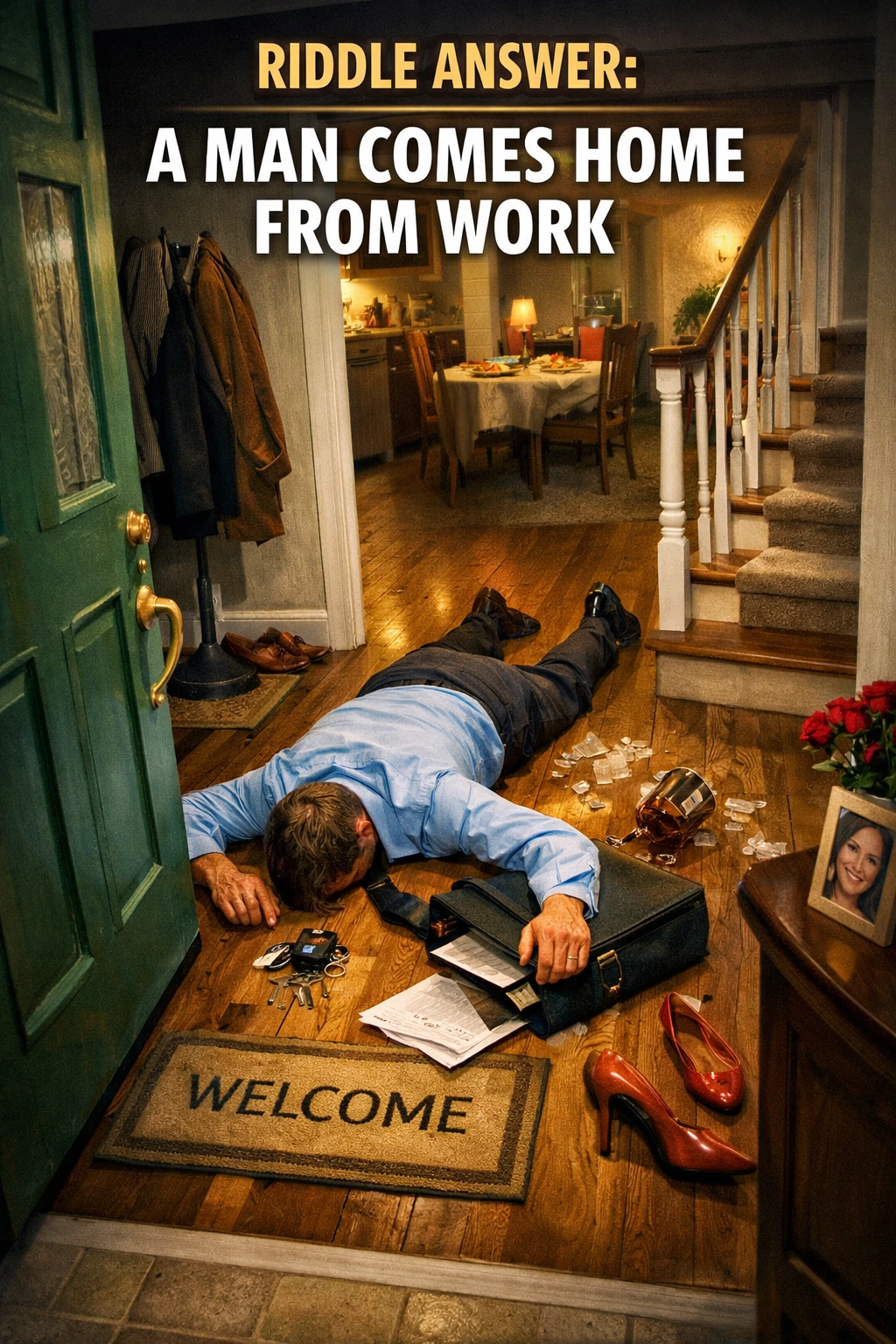
Riddles that rely on logic rather than wordplay often leave people puzzled long after hearing them. One of the most searched examples is the “a man comes home from work” riddle, a short story that seems ordinary at first but hides a critical clue in plain sight.
Many readers feel confused because nothing dramatic appears to happen—yet the man suddenly panics and calls the police. Why? The answer lies in understanding what doesn’t make sense, not what does.
In this article, you’ll find the complete answer, a step-by-step explanation, common misunderstandings, popular variations, and FAQs—all in one place.
Quick Answer
What Is the Answer to the “A Man Comes Home From Work” Riddle?
The man realizes his wife is in danger because she asks him to check the microwave timer—something she could easily do herself if she were safe. This unusual request signals distress, prompting him to call the police.
TL;DR
• The riddle hides its clue in an ordinary action
• The wife’s request doesn’t logically make sense
• The man notices something is wrong
• The microwave itself is not the danger
• The odd behavior signals an emergency
The Full Riddle Explained
The riddle usually goes like this:
A man comes home from work and hears his wife call from the bedroom, asking him to check how much time is left on the microwave. He looks, sees the time, and immediately runs outside to call the police.
At face value, nothing seems alarming. The microwave is running. Dinner is being prepared. His wife is home. So why does he panic?
The answer lies in behavioral logic. If the wife were safe and unhindered, she would have no reason to shout from another room to ask about the microwave. The request itself becomes the warning sign.
Why the Microwave Is the Key Clue
The microwave is not important because it’s dangerous. It’s important because it’s accessible.
If the wife can speak freely and move normally, she can simply walk to the kitchen. Asking her husband to check the timer suggests she may be prevented from leaving the room or is being watched.
This subtle inconsistency is what makes the riddle work.
What the Husband Realizes
The husband understands three things instantly:
• The request is unnecessary
• The situation doesn’t match normal behavior
• His wife may be in immediate danger
Because he can’t confirm what’s happening inside the bedroom, he chooses the safest response—calling the police.
Common Misunderstandings About the Riddle
Many incorrect explanations circulate online. Here are the most common ones:
• The microwave shows “9:11”
• The man is blind
• The microwave explodes
• The house is on fire
• The wife is testing him
None of these are required to solve the riddle. The simplest logical inconsistency is the correct answer.
Why This Riddle Is So Effective
This riddle works because it mimics real life. Nothing dramatic happens. There’s no obvious threat. The danger is revealed only by noticing behavior that doesn’t align with normal circumstances.
It tests your ability to:
• Question assumptions
• Notice subtle clues
• Think from a real-world perspective
That’s why so many people find it frustrating—and memorable.
Popular Variations of the Riddle
Over time, several versions of this riddle have appeared online:
• The microwave shows a strange time
• The wife whispers instead of calls
• The man checks a clock instead
• The setting changes to an oven
• The riddle is told as a trick question
Despite these changes, the core logic remains the same: the request itself signals danger.
FAQs
What is the main clue in the riddle?
The main clue is the wife asking her husband to check the microwave, which she could normally do herself.
Is the microwave dangerous in the riddle?
No. The microwave is only a tool used to highlight unusual behavior.
Why does the husband call the police immediately?
He realizes his wife may be unable to move freely or speak openly, indicating a serious threat.
Are there multiple correct answers to this riddle?
There are variations, but the widely accepted answer focuses on the illogical request.
Why do people overthink this riddle?
Because it feels too simple, many assume there must be a hidden twist when the clue is actually behavioral.
Is this riddle meant for adults or kids?
It’s suitable for both, but adults tend to overanalyze it more.
Conclusion
The a man comes home from work riddle answer isn’t about the microwave, hidden codes, or secret messages. It’s about noticing when everyday behavior suddenly stops making sense.
Once you focus on why the wife asked instead of what she asked, the solution becomes clear. That’s the brilliance of this riddle—it reminds us that the smallest details often reveal the biggest truths.
