
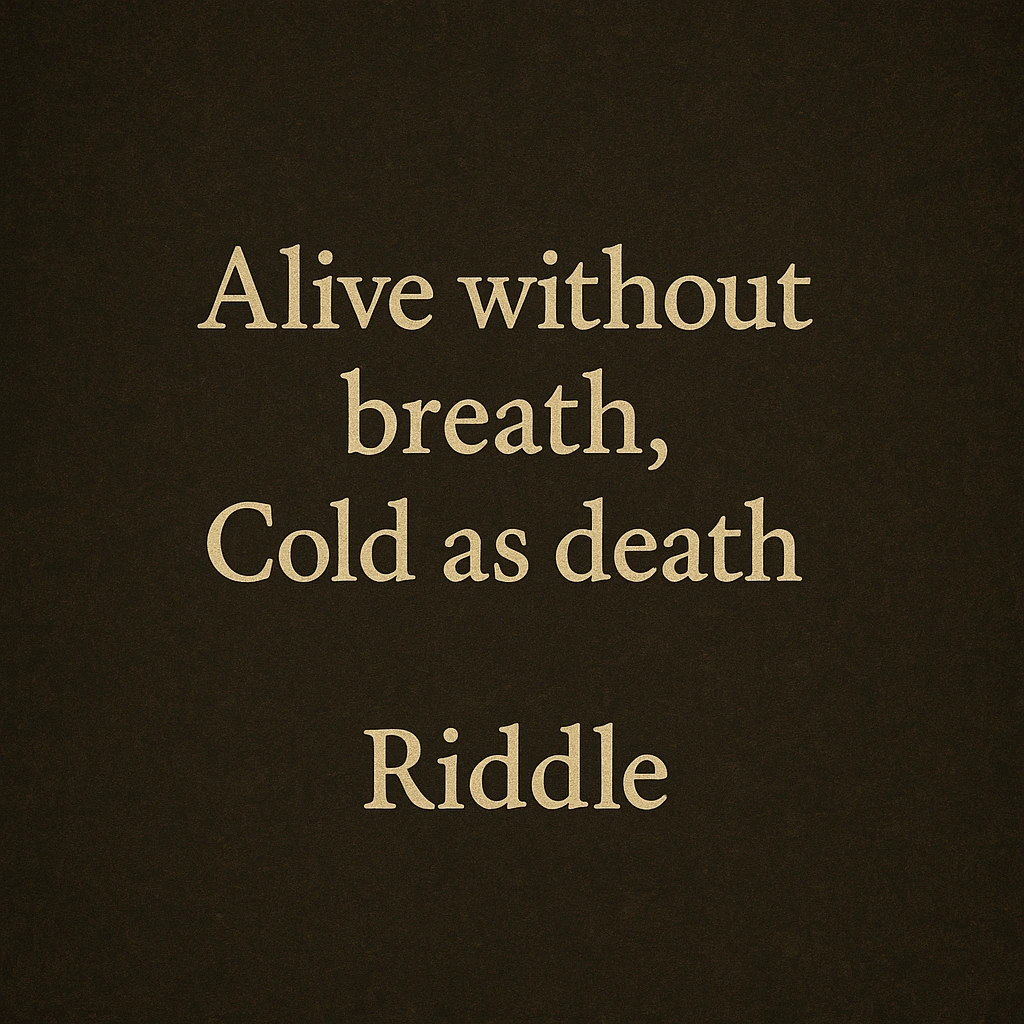
If you’ve ever seen the line “alive without breath, cold as death” float past your feed and wondered what on earth it means, you’re not alone. This verse is a classic fantasy riddle that also works as a quick brain teaser for families, classrooms, and riddle fans. In this guide, we’ll unpack the alive without breath cold as death riddle, explain why the answer is a fish, and walk through each clue step by step. You’ll also see how it connects to The Hobbit, discover kid-friendly explanations, and pick up ideas for sharing it at game night or online.
Quick Answer
The “alive without breath, cold as death” riddle describes a creature that lives in water, is cold-blooded, and wears armor-like scales. The answer is a fish, because fish breathe through gills instead of lungs, live surrounded by water, and are covered in quiet, mail-like scales.
Table of Contents
• “Alive Without Breath” Riddle Overview
• Answer to the “Alive Without Breath” Riddle
• Origin of This Classic Fish Riddle
• Full Lines of the “Alive Without Breath” Verse
• Why a Fish Solves This Riddle
• Meaning of “Never Thirsty, Ever Drinking”
• Meaning of “All in Mail Never Clinking”
• This Riddle in The Hobbit
• Versions of the “Alive Without Breath” Riddle
• Explaining This Riddle to Kids
• How Hard Is This Fish Riddle?
TL;DR
• The riddle’s answer is a fish.
• Each poetic line hints at fish biology.
• The verse appears famously in The Hobbit.
• Teachers use it to blend reading and science.
• Similar riddles focus on nature and creatures.
• Solving it means reading every clue together.
What Is the “Alive Without Breath, Cold as Death” Riddle?
This riddle is a short, rhyming description of something that sounds almost impossible. It’s “alive without breath” and “cold as death,” yet it keeps drinking without ever feeling thirsty. Those lines are designed to make you picture something living, but not in the usual way.
At its core, it’s a “What am I?” riddle that uses poetic clues instead of direct hints. The verse paints a picture of a cold creature, wrapped in armor, living in a world of water. Solvers are supposed to read each line, test guesses, and see which one fits every clue at once.
• Classic verse-style riddle built from short, rhyming lines.
• Presents a strange creature that doesn’t breathe like humans.
• Uses coldness to hint at a non-warm-blooded body.
• Mentions constant drinking to suggest a watery home.
• Adds armor imagery to point toward something scaled.
• Designed so one answer fits all clues perfectly.
• Often appears on puzzle sites and riddle lists.
• Popular in fantasy-loving and book-club communities.
• Short enough to memorize after hearing it once.
• Works for kids, teens, and adults with small tweaks.
• Sounds mysterious even after you know the answer.
• Stays family-friendly while still feeling clever.
What Is the Answer to the “Alive Without Breath” Riddle?
Most people meet this riddle because they want one thing: the answer. After you’ve read the lines and considered a few options, one creature checks every box. The solution is simple, but the way you get there feels satisfying.
The answer to the “alive without breath, cold as death” riddle is a fish. Once you think about how fish live, move, and breathe, every part of the verse suddenly makes sense, from the cold body to the quiet “mail” on its skin.
• The correct solution to the riddle is “fish.”
• Fish are living animals, so they count as “alive.”
• They do not breathe air with lungs like people do.
• Instead, they pull oxygen from water through gills.
• That difference supports the “without breath” idea.
• Being cold-blooded, their bodies match water temperature.
• That makes “cold as death” feel surprisingly accurate.
• Their home is water, so they are always surrounded.
• Constant contact with water fits “ever drinking.”
• Overlapping scales look like tiny plates of armor.
• Those scales don’t clink like metal chain mail.
• Put together, no other creature fits as neatly.
Where Does the “Alive Without Breath” Riddle Come From?
Today, you might see this verse on puzzle apps, worksheets, or social media screenshots. But it didn’t start as a random internet riddle. It first appeared in a beloved fantasy novel published in the 1930s.
The riddle is best known from J.R.R. Tolkien’s The Hobbit, during the “Riddles in the Dark” chapter. In that scene, Bilbo Baggins and the creature Gollum trade riddles by an underground lake. If Bilbo fails, he may never leave the cave. If he succeeds, he earns a way out.
• The verse comes from J.R.R. Tolkien’s book The Hobbit.
• It appears in the tense “Riddles in the Dark” chapter.
• Gollum is the one who asks this fish riddle there.
• Bilbo must answer correctly to stay in the game.
• The stakes are high: his life and freedom are threatened.
• Tolkien drew on older riddle and myth traditions.
• Over time, the verse spread beyond the novel’s pages.
• Puzzle books and websites later reprinted the riddle.
• Homework helpers now explain it for literature questions.
• Kids’ sites often present it without deep Tolkien context.
• Fantasy fans still quote it when discussing Gollum.
• It remains one of the most famous book-born riddles.
Full Text and Lines of the “Alive Without Breath” Riddle
Different sites show slightly different versions of the riddle, but they all share the same core lines. In Tolkien’s book, the verse appears as a short stanza that stacks clue upon clue about the same mysterious creature.
Modern pages sometimes trim or rearrange parts of the original wording. You’ll see forms like “I am alive without breath and cold as death” or longer versions that add extra lines about islands and fountains. No matter the version, all of them are describing the same thing.
• Original book form presents the riddle as a four-line stanza.
• The verse mixes life, cold, thirst, and armor imagery.
• The first line handles “alive” and “breath” in contrast.
• The second contrasts life with “cold as death” imagery.
• Later lines emphasize drinking without feeling thirsty.
• The final line talks about being wrapped in “mail.”
• Some editions include extra lines about drowning on land.
• Other versions simplify wording for younger readers.
• Short forms often start “I am alive without breath.”
• Long forms keep the full medieval-sounding rhythm.
• Teachers sometimes paraphrase lines into plain speech.
• All variants keep the answer as a fish at the center.
Why Is a Fish the Answer to This Riddle?
It might feel odd at first to call a fish “alive without breath.” After all, fish need oxygen just like people do. The trick is that they take it in a very different way. Instead of lungs that pull air from the sky, they use gills that pull oxygen from water.
Because water can be icy cold, fish bodies often feel chilly to the touch. That’s especially true in streams, lakes, or deep caves. Their overlapping scales form quiet, flexible armor that never clanks. Put all of that together, and the riddle’s clues match a fish almost perfectly.
• Fish are animals, so they clearly count as “alive.”
• They lack lungs that inhale and exhale air.
• Gills pull dissolved oxygen from the surrounding water.
• To human eyes, that looks like life without normal breathing.
• Their body temperature follows the water around them.
• In cold water, they feel almost as cold as ice.
• That supports the line about being “cold as death.”
• Water constantly passes through their mouths and gills.
• This continuous flow resembles nonstop drinking.
• Scales overlap like tiny shields across their bodies.
• Those scales resemble chain mail armor without noise.
• No other everyday creature fits every clue this well.
What Does “Never Thirsty, Ever Drinking” Really Mean?
The line about never feeling thirsty but always drinking confuses a lot of first-time solvers. If you imagine a person who is always drinking and never thirsty, the picture doesn’t make sense. But if you picture a fish instead, the line becomes much clearer.
Fish spend their whole lives surrounded by water. Many species pull water into their mouths and send it out across their gills so they can take in oxygen. That process looks like constant drinking, even though it isn’t thirsty sipping the way humans do with a glass.
• “Never thirsty” suggests a creature that doesn’t crave drinks.
• Constant water around the body means no dry feeling.
• Living in a lake or river keeps the mouth near water.
• Many fish continually move water through mouths and gills.
• That motion looks like endless little gulps from outside.
• The line turns a real process into playful poetry.
• It helps rule out land animals that drink occasionally.
• It also rules out machines that cannot feel thirsty.
• The image fits ocean and cave fish especially well.
• Explaining this line often requires a quick biology stop.
• Kids remember the clue once they picture fish breathing.
• The phrase shows how science can sound like magic.
What Does “All in Mail Never Clinking” Refer To?
The final armor line is one of the most important clues in the whole riddle. “Mail” here doesn’t refer to letters or email. It refers to medieval chain mail armor, made from metal rings linked together and worn by knights. That armor could clink and jingle when someone moved.
When you look at a fish, though, you see overlapping scales that form a quiet, flexible layer of protection. They look like tiny metal plates, but they don’t sound like armor. The riddle uses that comparison to guide you toward a scaled animal instead of a knight or machine.
• “Mail” means armor, not letters or packages.
• Historical mail armor used metal rings or small plates.
• When people walked in it, the rings could clink loudly.
• Fish scales stack like little plates over soft skin.
• That pattern looks very similar to chain mail.
• However, fish don’t make clinking metal noises.
• Their scales move silently as they swim through water.
• The line contrasts appearance and sound very cleverly.
• It rules out humans wearing armor as the answer.
• It also helps eliminate armored vehicles or robots.
• Kids enjoy comparing fish pictures to armor photos.
• The clue makes the final reveal feel especially neat.
“Alive Without Breath” in The Hobbit and Gollum’s Riddle Game
In The Hobbit, the fish riddle isn’t just a brain teaser; it’s part of a life-and-death game. Bilbo is lost in a dark cave beneath the Misty Mountains when he meets Gollum, a strange creature who lives on an underground lake and eats fish. They agree to trade riddles, and failure could cost Bilbo everything.
When Gollum asks the “alive without breath” riddle, he’s drawing on the thing he knows best: the fish he catches and eats. Bilbo struggles with several of Gollum’s verses, but he eventually answers correctly, keeping the game going a little longer and inching closer to escape.
• The riddle appears during Bilbo’s lowest moment underground.
• Gollum proposes a riddle game to decide Bilbo’s fate.
• Each character takes turns asking and answering challenges.
• Gollum’s riddles, including this one, feel dark and eerie.
• The fish image fits his lonely, watery life on the lake.
• Bilbo nearly panics yet keeps thinking through the lines.
• Solving this riddle proves his growing courage and wit.
• The scene deepens both characters without long explanations.
• Readers often remember this riddle long after finishing.
• Movie versions also highlight the cave riddle sequence.
• Many modern riddle lists credit Tolkien for the verse.
• The moment shows how stories can make puzzles unforgettable.
Versions and Variations of the “Alive Without Breath” Riddle
Because the riddle became so popular, it now exists in many slightly different forms. Some websites quote the original book lines almost word for word. Others shorten the wording, swap phrases, or add new lines while keeping the answer the same.
You might see versions that begin “I am alive without breath and cold as death,” or longer ones that mention drowning on dry land or thinking an island is a mountain. These extras still describe how badly a fish would handle life outside water, even if the tone feels more playful or dramatic.
• Original book versions use a four-line poetic stanza.
• Some sites preserve every line from that stanza.
• Short forms cut the armor reference or rearrange ideas.
• Kid-focused versions simplify the sentence structure.
• A few riddles add lines about dying on dry land.
• Others mention fountains, islands, mountains, and air.
• All these additions point to life in water versus land.
• The answer almost always remains “a fish” regardless.
• Variations help teachers match wording to reading level.
• Online, different versions spread through shares and memes.
• Fans sometimes remix the verse for themed game nights.
• The core mystery stays recognizable even with new twists.
How to Explain the “Alive Without Breath” Riddle to Kids
For younger kids, the language in this riddle can feel old-fashioned or spooky. The trick is to keep the magic but translate the hard phrases into words they already know. When you do that, the puzzle turns into a fun mix of poetry and basic animal science.
You can walk through each line slowly, stopping to ask what they picture. Then you can show a photo or toy fish, compare its scales to pretend armor, and talk about how gills work. Many children love the “aha” moment when they realize everything points to their favorite aquarium animal.
• Start by asking them to imagine a mystery creature.
• Read the riddle aloud in a calm, dramatic voice.
• After each line, pause and ask what it might mean.
• Translate “breath” into “breathing in air like us.”
• Explain that some animals breathe in different ways.
• Use a picture book or diagram of fish gills.
• Let them touch toy fish with raised scales like armor.
• Ask if the toy makes clinking metal sounds when moved.
• Invite several guesses, even if they’re wrong at first.
• Guide them back to water clues if they get stuck.
• Celebrate the solution, not just speed, when they answer.
• Encourage them to invent their own short creature riddles.
Is “Alive Without Breath” a Hard Riddle to Solve?
Difficulty can feel very different from person to person. Some adults recognize the riddle instantly from The Hobbit or from seeing it online. Others have never heard it and need time to sort out the metaphor. Many puzzle sites label it as a medium-level challenge.
For kids and teens, the riddle can feel tough the first time because they may focus on only one line. Once they learn to hold every line in their head at once, the answer becomes easier to see. That shift is part of what makes this verse such a good teaching tool.
• Many solvers rate the riddle medium difficulty.
• Prior Tolkien fans often solve it much more quickly.
• Young readers can struggle with older-style language.
• Focusing on one clue alone often leads to wrong answers.
• Holding all clues together makes the path clearer.
• Classroom discussions can balance the difficulty nicely.
• Group solving reduces pressure on shy students.
• Repeating the riddle builds comfort with poetic wording.
• Once solved, it becomes easier to recall next time.
• Some people enjoy using it as a “warm-up” puzzle.
• Others save it for themed fantasy game nights.
• Over time, it becomes more familiar than truly hard.
Riddles Similar to “Alive Without Breath, Cold as Death”
If you liked this fish puzzle, there are plenty of other verses that offer the same mix of poetry and logic. Some come from the same Hobbit chapter, while others appear on modern riddle lists that borrow the same style.
Most similar riddles describe ordinary things in a strange, almost magical way. You’ll find verses about eggs, time, wind, darkness, and everyday objects turned into puzzles. Reading them together is a fun way to compare how different clues guide you toward different answers.
• Other Hobbit riddles describe wind, dark, and time.
• Several classic riddles focus on eggs and hidden treasure.
• Modern lists add playful twists to these older verses.
• Many related riddles start with “I am” style lines.
• Nature and elements are common “What am I?” subjects.
• Some puzzles focus on light, shadows, or reflections.
• Others describe tools, furniture, or musical instruments.
• Fantasy-themed game nights often bundle such riddles.
• Teachers may create sets based on nature or seasons.
• Comparing answers helps students see pattern similarities.
• Similar riddles show how language turns facts into mysteries.
• The fish verse often anchors a whole themed riddle set.
How to Use This Riddle in Classrooms and Game Nights
Because the fish riddle is short, clean, and packed with imagery, it fits smoothly into both school settings and casual gatherings. In a classroom, it can start a lesson about figurative language, ecosystems, or character development in fantasy stories. At home, it works as an icebreaker before board games or movies.
You can write the riddle on the board, read it aloud, or print it on small cards. Then invite groups to work together before sharing guesses. After revealing the answer, you might ask students to write their own creature riddles, draw the clues, or compare this verse to another one from the same story.
• Use the riddle as a quick warm-up reading activity.
• Connect it to a chapter from The Hobbit in class.
• Pair the puzzle with short nonfiction about fish biology.
• Ask students to underline words that seem metaphorical.
• Let small groups brainstorm possible answers together.
• Have them explain why wrong guesses fail certain clues.
• Invite artwork showing the mystery creature from hints.
• Run a riddle circle at family game nights or parties.
• Read the verse dramatically and collect written guesses.
• Award small prizes for creative reasoning, not just speed.
• Encourage students to craft original “What am I?” riddles.
• Compile class riddles into a mini booklet or slideshow.
Tips for Solving “What Am I?” Riddles Like This One
This riddle is a great example of how “What am I?” puzzles hide everyday answers inside unusual descriptions. Once you know how to approach it, you can use the same approach on many other verses. The goal is to slow down, gather clues, and test each guess against all the lines, not just one.
By turning your focus toward categories, senses, and habitats, you can narrow the field quickly. Instead of leaping to the first idea, check whether it truly fits every hint. That habit turns riddle-solving from random guessing into satisfying detective work.
• Read the whole riddle once before guessing anything.
• Underline or highlight words that seem especially important.
• Group clues into categories like body, movement, and home.
• Ask whether the subject seems natural, magical, or man-made.
• Test early guesses against each line one by one.
• Be willing to discard an answer that fails even one clue.
• Consider whether the speaker sounds human, animal, or object.
• Look for strong contrasts, like life versus coldness.
• Notice any hints about sound, color, or texture.
• Think about how water, air, or ground might be involved.
• Remember that common answers often hide in fancy wording.
• Practice with several riddles to build solving confidence.
Fun Ways to Share the “Alive Without Breath” Riddle Online
In the digital world, this riddle has found a second life on social media and messaging apps. People post the verse as a challenge, hide the answer in comments, or send it in group chats to see who solves it first. Because it’s short, it fits nicely into captions and status updates.
If you share it, you might want to avoid spoiling the answer right away. Instead, give friends a few hours or a day to guess. Later, you can post a follow-up revealing the solution and maybe add a second related riddle to keep the game going.
• Turn the verse into a text-only image for posts.
• Share it as a caption and invite friends to comment answers.
• Send it in group chats as a quick mental break.
• Hide the answer behind a “spoiler” or second slide.
• Add a playful note promising a follow-up reveal later.
• Pair the riddle with fan art of an underwater scene.
• Use it as a warm-up question before online game sessions.
• Post a poll with a few silly wrong options included.
• Encourage kids to record themselves reading the verse aloud.
• Collect reactions from relatives who love fantasy stories.
• Build a short thread of related nature riddles underneath.
• Remind everyone to keep the answer kind and family-friendly.
Common Mistakes People Make with the “Alive Without Breath” Riddle
Even smart solvers fall into a few common traps when they first meet this riddle. One big mistake is focusing on a single phrase, like “alive without breath,” and forgetting to check the rest of the lines. Another is assuming that “mail” must refer to letters or messages instead of armor.
People also tend to overlook how strongly the clues point toward water. If you ignore the constant drinking and the armor that never clinks, you might end up guessing ghosts, statues, or other cold, quiet things that don’t actually match the full description.
• Many solvers forget to consider every line together.
• Some treat “without breath” as literal zero oxygen.
• Others assume the riddle must describe something magical.
• Focusing only on coldness leads toward ice or stone.
• Misreading “mail” as letters confuses the final clue.
• Few early guesses consider armor that makes no sound.
• Some answers ignore the “ever drinking” water idea.
• Others skip the possibility of gills instead of lungs.
• Overthinking can be as risky as guessing too fast.
• Reading the verse aloud often reveals hidden connections.
• Drawing the clues helps anchor the idea of a fish.
• Remembering these mistakes improves future solving attempts.
FAQs
Why is the “alive without breath” riddle so popular?
This riddle hits a sweet spot: it’s short, vivid, and tied to a famous fantasy story. Readers love that the answer is ordinary, but the path to it feels clever and magical. Because it appears in The Hobbit, fans often share it as a way to revisit a favorite scene.
Does “alive without breath” mean fish don’t breathe?
No. Fish do breathe; they just breathe differently than people. Instead of pulling air into lungs, they pull water over gills that collect dissolved oxygen, so it looks like life without normal, visible breathing.
Are there real-world lessons in this riddle?
Yes. The verse offers an easy doorway into talking about cold-blooded animals, gills, and aquatic habitats. It also shows how figurative language can turn simple facts into memorable, story-ready images that stick in people’s minds.
Can younger kids handle this riddle?
Most elementary-age kids can enjoy the riddle if an adult translates tricky phrases. When you explain words like “mail” and talk through each line, the puzzle becomes a fun mix of guessing game and science mini-lesson.
How can I tie this riddle into reading The Hobbit?
You can read the riddle scene aloud, let students try to solve it, then show how the book reveals the answer. After that, discuss what the riddle says about Gollum’s life on the underground lake and how the game tests Bilbo’s courage and quick thinking.
Is it okay if students already know the answer?
Absolutely. If some students know the answer, you can ask them to stay quiet at first and instead explain why the solution fits each line. That role turns them into helpers, not spoilers, and keeps the challenge alive for everyone else.
Are there good follow-up riddles after this one?
Great follow-ups include other verse puzzles about time, darkness, wind, and eggs. Many come from the same chapter or from modern riddle collections and give students more chances to practice reading clues carefully and testing their ideas.
Conclusion
The alive without breath cold as death riddle may be only a few lines long, but it holds a surprising amount of story, science, and style inside it. By seeing why a fish fits every clue, you also see how figurative language can make familiar creatures feel mysterious again. Whether you meet it in The Hobbit, on a worksheet, or in a friend’s group chat, this little verse offers a reliable way to spark curiosity and start conversations.
