
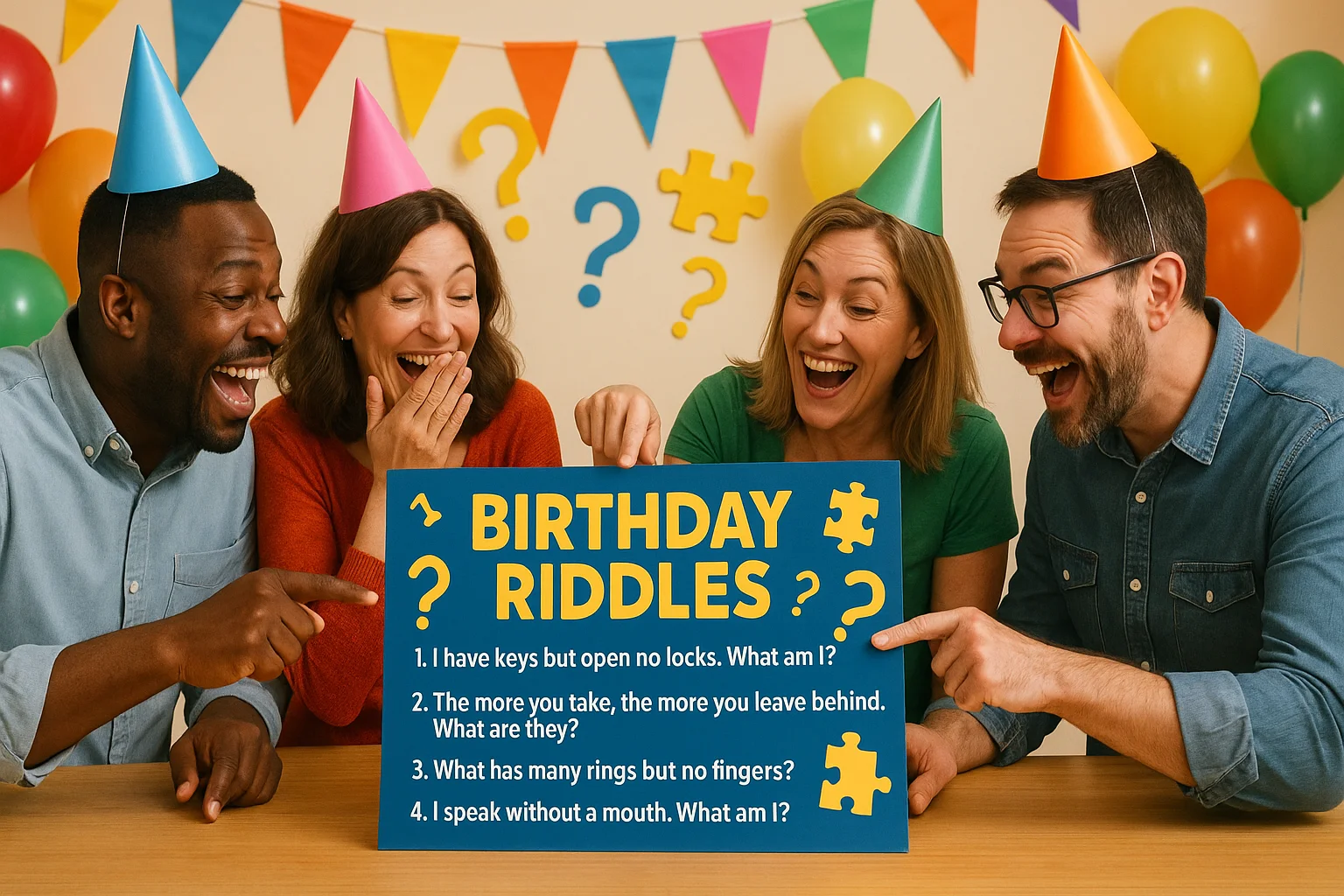
Adults don’t stop loving puzzles just because they’ve grown up. When people talk about birthday riddles for adults, they’re really talking about a playful tradition where word games, age jokes, and clever clues turn a simple party into something more meaningful.
In the United States, birthday riddles show up on party games, scavenger hunts, greeting cards, and even social media posts. They’re not just there for laughs. They quietly say something about how we feel about aging, friendship, and the idea of “another year around the sun.”
Today, birthday riddles are everywhere online, from long lists of funny puzzles to printable scavenger hunts and milestone-birthday sets. They’ve become part of a modern language of celebration, where a good brain teaser can stand in for a toast, a speech, or a big emotional moment.
Under the jokes, though, there are deep themes: time, identity, memory, and the choice to meet age with humor instead of fear. That’s where the symbolism lives.
Quick Answer
Birthday riddles for adults symbolize playful wisdom in the USA: they turn aging, time, and personal stories into light-hearted puzzles that help people laugh together, honor the guest of honor, and face another year with humor instead of worry.
Table of Contents
- What Are Birthday Riddles for Adults?
- Why Adults Still Love Birthday Riddles
- A Short History of Riddles in Celebrations
- How Birthday Riddles Reflect American Birthday Culture
- Funny Birthday Riddles and the Symbolism of Humor
- Age, Time, and “Over the Hill” Riddles
- Riddles About Cake, Candles, and Party Objects
- Flirty and Cheeky Birthday Riddles (Staying Respectful)
- Birthday Riddles as Icebreakers and Social Glue
- Scavenger Hunt and Surprise Party Riddles
- Cross-Cultural Views on Birthdays and Riddling
- Emotional and Psychological Meaning Behind Birthday Riddles
- Modern Uses: Cards, Social Media, Decor, and More
- Misunderstandings, Controversies, and Changing Tastes
- FAQs
- Conclusion
TL;DR
- Adult birthday riddles turn aging into a playful, shared experience.
- They symbolize wit, emotional closeness, and how we face time passing.
- American culture uses them in party games, toasts, and scavenger hunts.
- Themes include age, memory, identity, romance, and self-mockery.
- Cross-cultural roots lie in old riddle traditions and birthday rituals.
- Modern life pushes riddles onto social media, printables, and digital games.
What Are Birthday Riddles for Adults?
Birthday riddles for grown-ups are short puzzles tied to birthdays, age, or the person celebrating. They may be funny, sentimental, clever, or a bit teasing, but they’re usually still light and safe for mixed company.
Instead of simple “What has four legs?” puzzles, adult riddles often reference work, stress, relationships, and the feeling of getting older. That’s why they land differently than kids’ jokes: they mirror real adult worries, then turn them into something people can laugh about.
Typical Forms and Themes
• Rhyming couplets that hint at gifts, locations, or memories.
• One-line brain teasers about candles, cake, or the birthday year.
• Clever clues for scavenger hunts or “find your gift” games.
• Age jokes that poke fun at getting older without being truly cruel.
• Flirty or romantic puzzles shared between partners or close friends.
• Reflective riddles about time, growth, and life lessons.
Why Adults Still Love Birthday Riddles
At first, riddles sound like something you’d use only at a kids’ party. But adults keep coming back to them for a reason. In the 2020s, there are huge online collections with dozens or even hundreds of adult birthday riddles, often organized by difficulty, style, and age group. Puns Cafe+2Riddlioo+2
The symbolic pull is pretty simple: a riddle lets you say something honest—“you’re older,” “life is wild,” “we’ve come a long way”—without being heavy. It wraps truth in play.
What Riddles Quietly Signal About Adults
• We still want to feel clever, not just responsible.
• We’d rather laugh at aging than pretend it isn’t happening.
• We like rituals that make each birthday feel personal and unique.
• We enjoy being “seen” by puzzles tailored to our story or quirks.
• We use humor to handle awkward topics like age, money, or regret.
A Short History of Riddles in Celebrations
Riddles are much older than modern birthday parties. In ancient cultures, word puzzles showed up in myths, religious texts, and public contests. They tested wisdom, memory, and the ability to see beyond the obvious.
Over time, riddles shifted from sacred tests to social games. In Europe and the United States, they became party entertainment—shared around firesides, parlors, and later, living rooms and screens. Birthday-specific riddles are a modern twist on this: the old idea of proving your wit, tied to the yearly ritual of marking your age.
From Sacred Test to Party Game
• Ancient riddles often dealt with nature, gods, or fate.
• Medieval and early modern riddles moved into songs and tavern talk.
• Nineteenth-century parlor games brought puzzles into home gatherings.
• Twentieth-century joke books added birthday and holiday themes.
• Twenty-first-century blogs and printables target birthdays by age, style, and vibe. Fun Riddles for Kids+1
How Birthday Riddles Reflect American Birthday Culture
In the United States, birthdays are big social markers: turning 18, 21, 30, 40, and beyond often come with themed parties, jokes, and sometimes anxiety. Birthday riddles fit right into this culture of “marking” each year with something memorable.
Online guides stress how riddles can make parties feel more personal, especially when clues reference the person’s job, habits, or favorite hobbies. myCityHunt.com+1 That personalization is a key part of the symbolism: it says, “We know you well enough to turn your life into a puzzle.”
Key Contexts at a Glance
| Context | Meaning in the USA | Common Associations | Notes |
| Party icebreakers | Warm up guests, break social awkwardness | Laughter, group bonding | Common at home gatherings and offices |
| Toasts and speeches | Wrap serious praise in playful language | Compliments, mild teasing | Often used instead of long speeches |
| Greeting cards | Make a simple card feel more thoughtful | Wordplay, inside jokes | Popular in store-bought and DIY cards |
| Scavenger hunts | Turn gift-giving into a story or “quest” | Adventure, surprise, movement | Big trend for at-home and outdoor parties |
| Milestone birthdays (30, 40, 50…) | Face age head-on with humor and wit | “Over the hill,” wisdom, resilience | Can shift tone from anxious to celebratory |
Funny Birthday Riddles and the Symbolism of Humor
Most birthday riddles for adults lean funny, not philosophical. But that humor carries symbolic weight. It says that laughter is the main “shield” we use against stress, aging, and the pressure to have life figured out.
Modern collections often highlight “funny birthday riddles for adults” as their own section, with jokes about work, exhaustion, and being “burnt out” like candles. Daily Riddles+1
What Birthday Humor Says About Us
• We see birthdays as a chance to tease—but with affection, not cruelty.
• We accept that life is stressful, so we celebrate any excuse to laugh.
• We treat humor as social glue that links old friends and new guests.
• We use jokes to handle topics that might otherwise feel embarrassing.
• We prefer light sarcasm and gentle age jokes over harsh “roasting.”
Age, Time, and “Over the Hill” Riddles
Many adult riddles circle around age itself: “What gets bigger every year but no one wants more of?” or “I come once a year, add a candle, and never repeat. What am I?” These puzzles echo a long human habit—turning time into a character you can talk to, chase, or complain about.
In the US, “over the hill” party themes used black balloons and grim jokes about being old. Today, some people still like that style, but many prefer warmer, kinder humor that remembers the guest’s achievements and resilience. Fashion Blogger
Symbolic Ideas Around Age Riddles
• Age as a “number riddle” you can joke about instead of fear.
• Candles as symbols of both life and limits on time.
• Clocks and calendars as playful reminders that days keep passing.
• “Older but wiser” as a key message hidden in many puzzles.
• Turning anxieties about wrinkles or regrets into shared laughter.
Riddles About Cake, Candles, and Party Objects
Birthday riddles often focus on the objects on the table: cake, candles, balloons, gifts, and decorations. On the surface, they’re just easy clues. Symbolically, they flip everyday items into little metaphors.
Websites full of birthday riddles highlight these props again and again—cake as the “star” of the dessert table, balloons that “lift spirits,” candles that “strike” or “go on vacation” when people are burnt out. Simply Riddles+2Daily Riddles+2
Common Objects and Their Symbolic Roles
• Cake: celebration, community, and the “sweetness” of life.
• Candles: life, hope, and the limited nature of time.
• Balloons: lightness, joy, and sometimes fragile feelings.
• Gifts: mystery, generosity, and hidden sides of a person.
• Confetti and streamers: bursts of joy that don’t last long.
• Party hats: playful status—today, you’re the “crowned” guest.
Flirty and Cheeky Birthday Riddles (Staying Respectful)
Some adult birthday riddles take a flirty or slightly cheeky turn, especially between partners or in close friend groups. They may sound suggestive at first, then resolve in an innocent answer like “cake,” “candles,” or “your birthday wish.” Riddlioo
Symbolically, these riddles play with the boundary between public and private, or between childhood and adulthood. They show that birthdays are still about fun, but also about attraction, intimacy, and grown-up relationships.
Healthy Lines for Flirty Puzzles
• Keep them consensual and aimed at people who enjoy that style.
• Let the final answer be light, not graphic or degrading.
• Avoid targeting body issues, past trauma, or sensitive topics.
• Prefer double meanings that feel clever, not mean-spirited.
• Remember that mixed-age or work events call for gentler content.
Birthday Riddles as Icebreakers and Social Glue
In a room of people who don’t all know each other, riddles can do what small talk can’t. They focus attention, give everyone the same “problem,” and create instant moments of shared success or shared confusion.
Guides for adult parties often recommend birthday-themed riddles as icebreakers, especially when they’re personalized with details about the guest of honor’s hobbies, job, or favorite places. myCityHunt.com
How Riddles Help People Connect
• They give shy guests a script so they don’t have to improvise.
• They shift focus from individuals to a shared challenge.
• They make it easier to laugh with someone instead of at them.
• They let older and younger guests meet on equal footing.
• They create memorable phrases people will quote later.
Scavenger Hunt and Surprise Party Riddles
One of the fastest-growing uses of birthday riddles is in scavenger hunts. Hosts hide clues around a house, backyard, or city, each puzzle pointing toward the next location or gift.
Recent printable kits and blog posts show how popular this has become, especially for teens and adults who prefer an “experience” over a simple gift hand-off. Beccaren+2Scavenger Hunt+2
Symbolism of the Birthday “Quest”
• The birthday person becomes a hero in a small personal adventure.
• Each clue represents a memory, trait, or shared joke from their life.
• The final gift stands for “treasure” at the end of another year.
• Moving from place to place mimics moving through stages of life.
• Friends act as guides or companions on the “journey.”
Cross-Cultural Views on Birthdays and Riddling
Not every culture treats birthdays the same way. In some traditions, name days, religious milestones, or harvest times matter more than exact birth dates. Still, riddles and word games appear around the world as tools for teaching, testing, and entertaining.
In many European and North American contexts, modern birthday riddles blend older riddle traditions with newer party customs. In other places, riddles might show up more in festivals, markets, or storytelling circles than in birthday parties.
Shared Themes Across Cultures
• Using puzzles to teach children values and practical wisdom.
• Respect for elders expressed through stories, not just gifts.
• Turning big life moments into shared games instead of pure ceremony.
• Using wordplay to speak indirectly about sensitive subjects.
Emotional and Psychological Meaning Behind Birthday Riddles
Underneath the jokes, birthday riddles for adults carry emotional weight. They let people admit mixed feelings—pride, regret, hope, fear—without putting those feelings into direct, heavy sentences.
Psychologically, riddles invite a shift in perspective. To solve one, you have to look at time, age, or identity from a fresh angle. That same shift can soften how someone feels about “getting older.”
Inner Messages Riddles Often Carry
• “You’re still sharp, and we see your intelligence.”
• “Yes, time is passing, but you’re not facing it alone.”
• “Your story is interesting enough to be turned into a game.”
• “We remember your habits, your jokes, and your private symbols.”
• “You can laugh at what scares you, and that’s a kind of strength.”
Modern Uses: Cards, Social Media, Decor, and More
Today, birthday riddles for adults live far beyond the party room. Sites offer collections of printable riddles, caption ideas, and card messages ready to drop into invitations, decor, or posts. Wishful Birthday+1
Instead of just writing “Happy Birthday,” people might share a riddle on an Instagram story, add one to a TikTok caption, or print it on a mug. The symbol here is clear: the person isn’t just older—they’re someone worth a customized puzzle.
Where You’ll See Birthday Riddles Now
• Inside greeting cards, both store-bought and handmade.
• As captions or polls on birthday social media posts.
• Printed on banners, chalkboard signs, or party backdrops.
• On scavenger hunt clue cards taped around the house.
• In digital trivia games for virtual or hybrid gatherings.
Misunderstandings, Controversies, and Changing Tastes
Like any humor, birthday riddles can misfire. Some older age jokes leaned heavily on fear of becoming “useless” or “invisible” after a certain birthday. Others made fun of weight, body changes, or mental health in ways that feel harsh now.
Recent guidance on birthday games stresses “light sarcasm” and “gentle” humor that doesn’t hurt feelings, especially around age, gender, or appearance. Fashion Blogger This shift reflects broader cultural changes toward kindness and inclusivity.
Pitfalls to Watch For
• Jokes that shame people for being single, child-free, or divorced.
• Puzzles that rely on stereotypes about gender or race.
• Riddles that tease sensitive topics like illness or job loss.
• “Dirty” riddles dropped into a group that didn’t agree to that tone.
• Overusing jokes about being “old” in a way that feels cruel.
FAQs
Are birthday riddles for adults still popular today?
Yes. In the mid-2020s, there are many new collections, printables, and blogs devoted just to adult birthday riddles. They’re used at home parties, offices, and online celebrations because they’re cheap, flexible, and easy to customize.
What do birthday riddles for adults usually symbolize?
They mainly symbolize playful wisdom and social connection. A riddle says, “We know you, we care about your story, and we want you to feel clever and celebrated—not just older.”
How are adult birthday riddles different from kids’ versions?
Kids’ riddles tend to be simple, visual, or silly, while adult versions include themes of work, stress, romance, and time passing. However, both share a love of surprise and a desire to turn everyday objects into little mysteries.
Is it okay to use “over the hill” or age-based riddles?
It can be, but tone matters. If the person enjoys dark humor and has agreed to that style, age-heavy riddles might land well. For mixed groups or sensitive guests, it’s better to focus on wisdom, memories, and hope instead of fear or mockery.
How can I make my birthday riddles more meaningful?
Tie each riddle to a real part of the person’s life—a favorite coffee mug, a running joke, a work habit, or a shared memory. When the answer reveals something personal, it turns the puzzle into a tiny love letter.
Can birthday riddles have a spiritual or reflective side?
Yes. Some people write reflective riddles about time, purpose, or gratitude, especially for milestone birthdays. These puzzles still feel playful, but they gently invite the birthday person to think about where they’ve been and where they’re going next.
Conclusion
When you look closely, birthday riddles for adults are more than party fluff. They turn age, time, memory, and even anxiety into a shared game, letting people face another year with smiles instead of dread.
In American life, these riddles quietly symbolize playful wisdom, emotional closeness, and the idea that our stories are worth celebrating out loud. Each puzzle is a small ritual: a reminder that growing older doesn’t mean losing your sense of fun or your sharp mind.
Whether they’re printed on cards, hidden in scavenger hunts, or spoken in a toast, birthday riddles keep saying the same thing: you’re still a mystery worth exploring—and we’re glad we get to solve a little more of it with you each year.

Christopher Adams is a puzzle enthusiast and riddle creator from the USA. He is known for mixing humor with logic, producing riddles that make readers laugh while they think.