
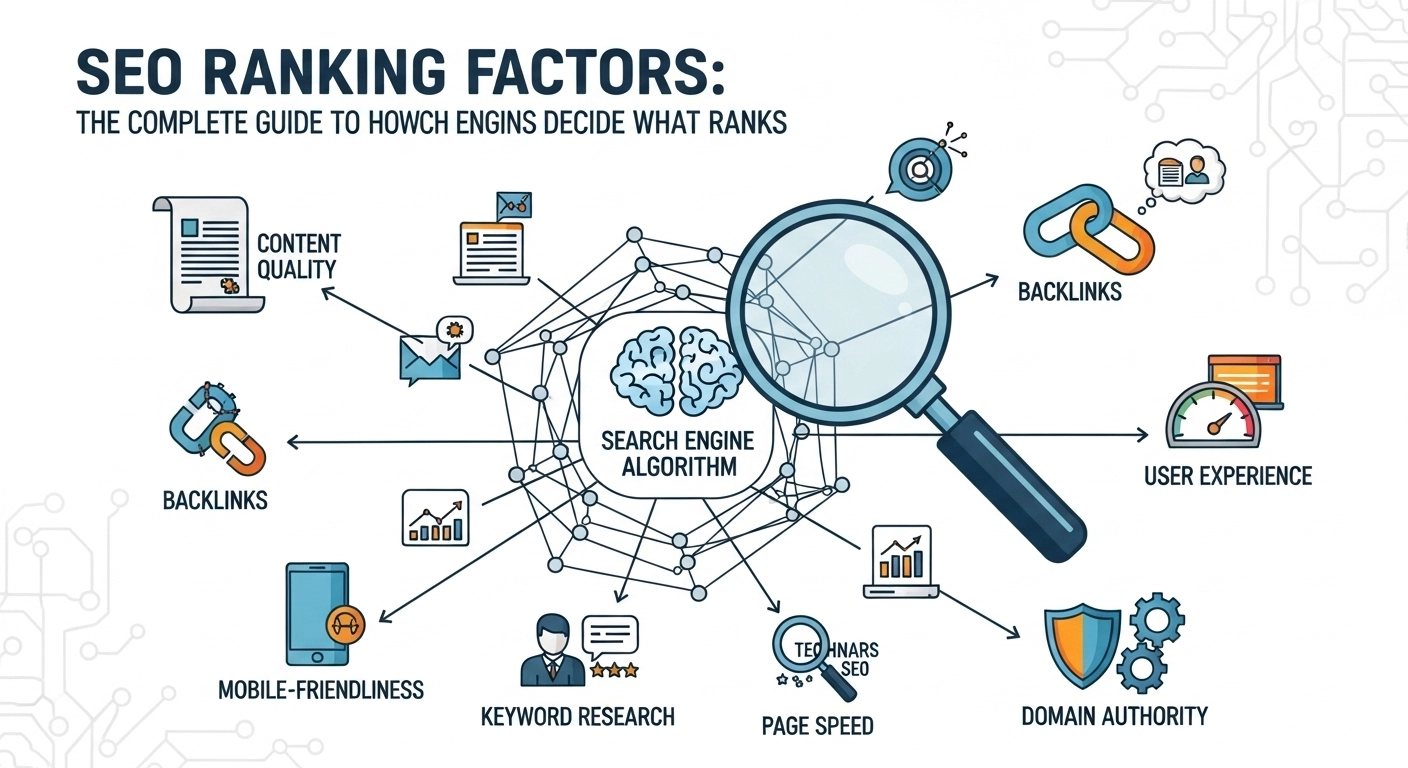
Why do some websites appear at the top of search results while others remain invisible? The answer lies in ranking factors—signals used by search engines to evaluate and order web pages based on relevance, quality, and usefulness.
Understanding these factors is essential for anyone who wants consistent visibility online. Whether you run a blog, an eCommerce store, or a business website, your success depends on how well your content aligns with what search engines value.
This guide breaks down all the important ranking factors in a clear, practical way. You’ll learn not just what matters, but how to apply it effectively.
Quick Answer: What Are SEO Ranking Factors?
SEO ranking factors are the criteria search engines use to determine where a webpage appears in search results. These include content quality, relevance, backlinks, user experience, technical performance, and more.
In simple terms:
Websites rank higher when they provide valuable content, load quickly, are easy to use, and are trusted by other websites.
Content Quality: The Foundation of Rankings
Content is the core of search visibility. Without strong content, no amount of technical work or backlinks will sustain long-term rankings.
Relevance to Search Intent
Search engines prioritize content that matches what users are actually looking for. This is called search intent.
There are four main types of intent:
- Informational (learning something)
- Navigational (finding a specific site)
- Transactional (buying something)
- Commercial (research before purchase)
If your content doesn’t match intent, it won’t rank—no matter how well-written it is.
Depth and Usefulness
Thin content rarely performs well. Pages that provide detailed, helpful, and complete information tend to rank higher.
For example, a short 300-word article about “digital marketing” will struggle compared to a comprehensive guide that explains strategies, tools, and examples.
Originality and Value
Search engines reward original insights, unique perspectives, and real value. Rewriting existing content without adding anything new is unlikely to succeed.
On-Page Optimization Factors
On-page elements help search engines understand your content clearly.
Title Tags and Headings
The title tag is one of the strongest signals. It should:
- Include your main keyword naturally
- Be clear and compelling
- Match the content
Headings (H1, H2, H3) structure your content and improve readability.
Keyword Usage
Keywords still matter, but not in the old way. Instead of stuffing keywords, focus on:
- Natural placement
- Semantic variations
- Contextual relevance
Search engines now understand topics, not just exact phrases.
URL Structure
Clean, simple URLs perform better. For example:
- Good: yoursite.com/seo-ranking-factors
- Bad: yoursite.com/page?id=1234
Internal Linking
Linking to other pages on your website helps:
- Distribute authority
- Improve navigation
- Increase time spent on your site
Backlinks: Authority and Trust
Backlinks remain one of the most powerful ranking factors.
What Are Backlinks?
Backlinks are links from other websites pointing to your content. They act as votes of confidence.
Quality Over Quantity
A few high-quality backlinks from authoritative sites are far more valuable than hundreds of low-quality links.
Relevance Matters
Links from websites in your niche carry more weight than unrelated ones.
For example, a link from a marketing blog is more valuable for a marketing website than a link from an unrelated site.
User Experience (UX) Signals
Search engines increasingly focus on how users interact with your website.
Page Experience
A good user experience includes:
- Easy navigation
- Clean design
- Readable content
Core Web Vitals
These are performance metrics that measure:
- Loading speed
- Interactivity
- Visual stability
Slow or unstable pages tend to rank lower.
Mobile Friendliness
Most users browse on mobile devices. A mobile-friendly site is essential for ranking.
Technical Factors
Technical health ensures search engines can crawl and understand your site.
Crawlability and Indexing
Search engines must be able to:
- Access your pages
- Understand your content
- Index your site correctly
Blocked or broken pages won’t rank.
Site Speed
Fast-loading websites improve both user experience and rankings. Even a one-second delay can impact engagement.
Secure Connection (HTTPS)
Security is a ranking signal. Websites using HTTPS are preferred over non-secure ones.
Content Freshness
Regularly updated content performs better in many cases, especially for topics that change frequently.
For example:
- News
- Trends
- Technology
Updating old content can often boost rankings without creating new pages.
E-E-A-T: Experience, Expertise, Authority, Trust
Search engines evaluate content based on:
- Experience: Has the writer actually used or experienced the topic?
- Expertise: Is the content knowledgeable?
- Authority: Is the site recognized in its field?
- Trust: Is the content reliable and accurate?
This is especially important for topics related to health, finance, or important decisions.
Behavioral Signals
Although indirect, user behavior influences rankings.
Click-Through Rate (CTR)
If users frequently click your result, it signals relevance.
Dwell Time
If users stay longer on your page, it suggests your content is valuable.
Bounce Rate
A high bounce rate may indicate poor user experience or mismatched intent.
Important Factors People Often Overlook
Many focus only on keywords and backlinks, but overlook critical elements.
Content Structure
Well-structured content is easier to read and understand. Use headings, short paragraphs, and logical flow.
Image Optimization
Images should:
- Load quickly
- Have descriptive alt text
- Support the content
Consistency
Publishing regularly and maintaining quality builds long-term authority.
Topical Authority
Instead of writing one article on a topic, create multiple related pieces that cover the subject deeply.
Common Mistakes and Misconceptions
Keyword Stuffing Still Works
It doesn’t. Overusing keywords harms readability and rankings.
More Content Means Better Rankings
Quantity alone doesn’t help. Quality and relevance matter more.
Backlinks Are All That Matter
Backlinks are important, but without strong content and user experience, they won’t sustain rankings.
Ignoring Technical Issues
Broken pages, slow speed, and poor structure can silently damage performance.
Practical Tips and Best Practices
Focus on creating content that genuinely helps users. Start by understanding what your audience needs and build around that.
Write clear, detailed, and structured content. Avoid unnecessary complexity.
Improve your website speed and ensure it works smoothly on mobile devices.
Build backlinks naturally by creating valuable content that others want to reference.
Update older content regularly instead of always creating new pages.
Pay attention to analytics. Understand what works and refine your approach over time.
FAQs
What is the most important ranking factor?
There is no single factor. Content quality, relevance, and backlinks together have the biggest impact.
How long does it take to see results?
It can take weeks to months depending on competition, content quality, and consistency.
Are backlinks still important?
Yes, they remain one of the strongest signals of authority and trust.
Does website speed affect rankings?
Yes. Faster websites provide better user experience and tend to rank higher.
Can I rank without backlinks?
It’s possible in low-competition niches, but backlinks significantly improve your chances.
Conclusion
Ranking factors are not about tricking search engines—they are about creating the best possible experience for users.
When your content is useful, your site is fast and easy to use, and other websites trust you enough to link to you, higher rankings naturally follow.
Instead of chasing shortcuts, focus on long-term quality. Build valuable content, improve user experience, and maintain technical health. This approach not only improves rankings but also builds lasting credibility and success.

David Miller is a USA-based puzzle blogger known for his sharp and tricky riddles. With a background in logic games and quizzes, his work focuses on keeping readers hooked with every twist and turn.