
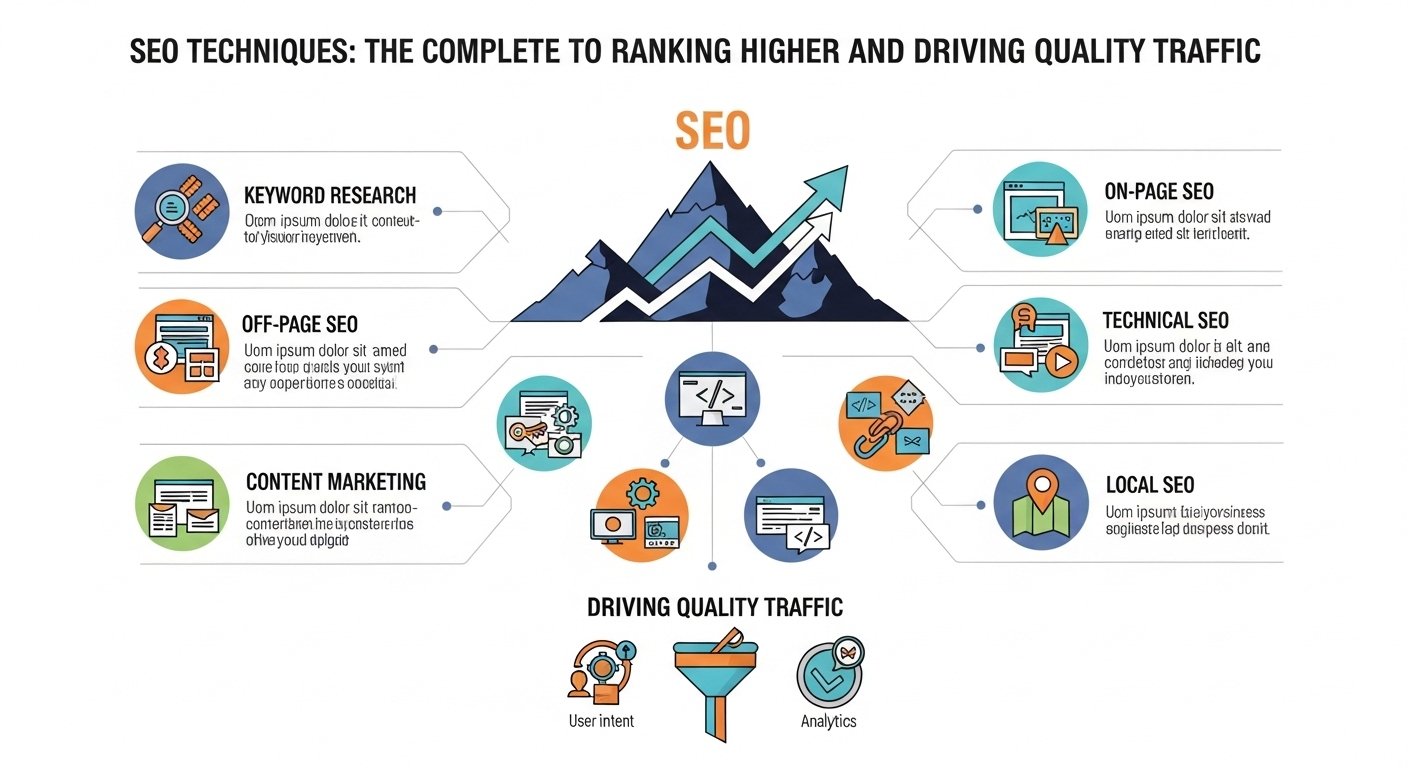
If you want your website to attract consistent, high-quality traffic, you need more than just great content—you need the right strategies to make that content visible. This is where effective SEO techniques come into play.
Search engines are the primary gateway to the internet. Whether someone is looking for information, products, or services, they rely on search results to guide them. If your website doesn’t appear near the top, it might as well not exist.
This article is a complete, practical guide to modern SEO techniques. It covers everything from foundational principles to advanced strategies, helping beginners get started and giving experienced users deeper insights to refine their approach.
Quick Answer: What Are SEO Techniques?
SEO techniques are methods used to improve a website’s visibility in search engine results. These include optimizing content, improving technical performance, building authority through links, and enhancing user experience—all to help your pages rank higher and attract more relevant visitors.
Understanding the Core of SEO
Before diving into techniques, it’s important to understand how search engines work. They crawl websites, index content, and rank pages based on relevance and quality.
Your goal is to make your site easy to understand, valuable to users, and trustworthy in your niche.
SEO can be broadly divided into three pillars:
- On-page SEO (content and page-level improvements)
- Off-page SEO (authority and backlinks)
- Technical SEO (performance and structure)
Each plays a crucial role, and success comes from combining all three effectively.
On-Page SEO Techniques
Keyword Research and Intent Matching
Every successful strategy begins with understanding what people are searching for.
Instead of targeting random keywords, focus on search intent. Ask yourself: is the user looking for information, a product, or a solution?
For example, someone searching “best budget smartphones” wants comparisons, not a product page.
Use a mix of:
- Short-tail keywords (broad topics)
- Long-tail keywords (specific phrases)
- Question-based queries
Naturally incorporate them into your content without overstuffing.
High-Quality Content Creation
Content is the foundation of SEO. But not just any content—your content must be:
- Useful and informative
- Easy to read
- Well-structured
- Updated and accurate
Focus on solving real problems. The more helpful your content is, the more likely users will stay, share, and return.
Title Tags and Meta Descriptions
Your title is the first thing users see in search results. It should:
- Be clear and compelling
- Include your main keyword
- Encourage clicks
Meta descriptions don’t directly affect rankings, but they improve click-through rates, which indirectly helps performance.
Proper Use of Headings
Headings (H1, H2, H3) help both users and search engines understand your content structure.
Use them to:
- Break content into sections
- Highlight key ideas
- Improve readability
Avoid stuffing keywords into every heading. Keep them natural and meaningful.
Internal Linking
Internal links guide users and search engines through your website.
They help:
- Distribute authority across pages
- Improve navigation
- Increase time spent on site
Link related pages naturally within your content to provide additional value.
Technical SEO Techniques
Website Speed Optimization
A slow website frustrates users and harms rankings.
To improve speed:
- Compress images
- Minimize unnecessary scripts
- Use caching
- Choose reliable hosting
Even a one-second delay can reduce conversions significantly.
Mobile-Friendliness
Most users browse on mobile devices. Your site must:
- Be responsive
- Load quickly on mobile
- Offer easy navigation
A poor mobile experience can lead to high bounce rates and lower rankings.
Secure Website (HTTPS)
Security is a ranking factor. Always use HTTPS to:
- Protect user data
- Build trust
- Improve credibility
Search engines prioritize secure websites over non-secure ones.
Crawlability and Indexing
Ensure search engines can access and understand your site.
Key steps include:
- Creating an XML sitemap
- Using a robots.txt file correctly
- Fixing broken links
- Avoiding duplicate content
If search engines can’t crawl your site, your content won’t rank—no matter how good it is.
Off-Page SEO Techniques
Link Building
Backlinks are one of the strongest ranking signals. When other websites link to you, it signals trust and authority.
Effective methods include:
- Guest posting
- Creating shareable content
- Building relationships with other site owners
- Earning links through valuable resources
Focus on quality over quantity. A few strong links are better than many weak ones.
Brand Mentions and Authority
Even without direct links, mentions of your brand online help build credibility.
The more your brand is recognized across the web, the more trustworthy your site appears.
Social Signals
While not a direct ranking factor, social engagement can amplify your content reach.
More visibility often leads to:
- Increased traffic
- More backlinks
- Higher brand awareness
Content Optimization Techniques
User Experience (UX)
Search engines prioritize user satisfaction. Your content should be:
- Easy to read
- Well-formatted
- Visually appealing
Use short paragraphs, clear fonts, and logical flow.
Content Freshness
Regularly update your content to keep it relevant.
Fresh content signals that your site is active and up-to-date.
Multimedia Integration
Adding images, videos, and infographics can:
- Improve engagement
- Increase time on page
- Enhance understanding
Just ensure media files are optimized for speed.
Local SEO Techniques
If you serve a specific area, local SEO is essential.
Optimize for local searches by:
- Creating a business profile
- Using location-based keywords
- Collecting customer reviews
- Ensuring consistent contact details
Local SEO helps you appear in nearby searches and map results.
Advanced SEO Techniques
Schema Markup
Structured data helps search engines understand your content better.
It can also enhance your listings with rich snippets like:
- Ratings
- FAQs
- Product details
This improves visibility and click-through rates.
Voice Search Optimization
With the rise of voice assistants, optimize for conversational queries.
Focus on:
- Natural language
- Question-based keywords
- Clear, direct answers
Topic Clusters
Instead of isolated articles, create content clusters around a main topic.
This involves:
- A pillar page (main topic)
- Supporting pages (related subtopics)
This structure strengthens authority and improves rankings.
Important Points People Often Overlook
Many focus only on keywords and backlinks but ignore critical factors like:
- Search intent alignment
- Content readability
- Page experience
- Consistency in publishing
Even small improvements in these areas can make a significant difference.
Common Mistakes and Misconceptions
One of the biggest mistakes is keyword stuffing. Adding too many keywords makes content unnatural and can harm rankings.
Another misconception is that SEO delivers instant results. In reality, it’s a long-term process that requires patience and consistency.
Other common mistakes include:
- Ignoring mobile users
- Publishing thin or duplicate content
- Buying low-quality backlinks
- Neglecting technical issues
Avoiding these pitfalls is just as important as applying the right techniques.
Practical Tips and Best Practices
To succeed with SEO, focus on consistency and quality.
Start with strong fundamentals. Build content that genuinely helps users. Optimize your site for speed and usability.
Track your performance and adjust strategies based on data. What works today may need refinement tomorrow.
Always prioritize the user. If your content satisfies visitors, search engines will reward you.
Frequently Asked Questions (FAQs)
What is the most important SEO technique?
There is no single most important technique, but high-quality content combined with proper keyword targeting and strong backlinks is essential for success.
How long does SEO take to show results?
SEO is a long-term strategy. You may start seeing improvements within a few months, but significant results often take 6 to 12 months.
Is SEO better than paid advertising?
Both have their advantages. SEO provides long-term, sustainable traffic, while paid ads deliver immediate results. Ideally, use both together.
Can I do SEO without technical knowledge?
Yes, many basic techniques like content optimization and keyword research are beginner-friendly. However, advanced strategies may require technical understanding.
How often should I update my content?
Review and update important content every few months to keep it accurate, relevant, and competitive.
Conclusion
SEO is not a one-time task—it’s an ongoing process that evolves with search engine algorithms and user behavior. By mastering the right techniques, you can build a strong online presence, attract consistent traffic, and stay ahead of the competition.
Focus on delivering value, maintaining quality, and adapting to changes. When done correctly, SEO becomes one of the most powerful tools for long-term digital success.

Shel Silverstein was a multi-talented poet, songwriter, and children’s author from the USA. His playful poems often felt like riddles in disguise, blending humor with deep meaning, making him a timeless favorite for puzzle and word lovers.