
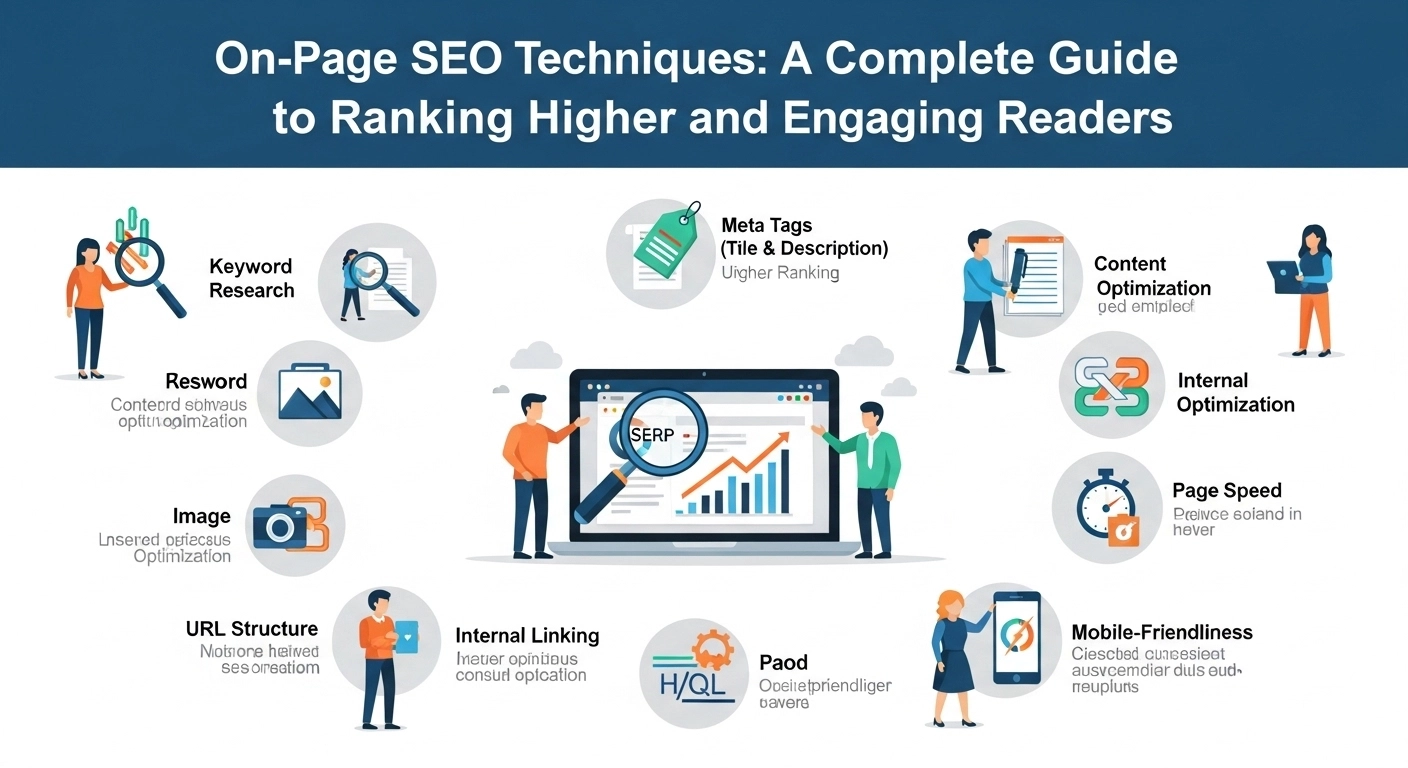
If you want your website to attract consistent, high-quality traffic, mastering on-page techniques is essential. These are the elements you control directly on your website—your content, structure, and user experience. When done right, they help search engines understand your pages while making your content more valuable and enjoyable for readers.
This guide walks you through everything you need to know, from the fundamentals to advanced strategies, with practical examples and actionable steps you can apply immediately.
Quick Answer: What Are On-Page SEO Techniques?
On-page SEO techniques are methods used to optimize individual web pages so they rank higher in search results and provide a better user experience. This includes optimizing content, headings, HTML tags, images, internal links, and overall page structure.
In simple terms, it’s about making your page clear, relevant, and helpful—for both users and search engines.
Why On-Page Optimization Matters
On-page optimization is the foundation of visibility. Without it, even great content can remain hidden.
It matters because it:
- Helps search engines understand your content
- Improves user experience and engagement
- Increases click-through rates from search results
- Supports higher rankings over time
- Builds trust and credibility with readers
Unlike external strategies, on-page improvements are fully within your control, making them one of the most powerful tools available.
Core On-Page SEO Techniques
Keyword Research and Placement
Every page should target a specific topic or keyword. Start by identifying what your audience is searching for.
Once you have your keyword, place it naturally in:
- The title
- The first paragraph
- Headings
- URL
- Meta description
- Image alt text
Avoid forcing it. Write for humans first, then refine for clarity and relevance.
Crafting High-Quality Content
Content is the heart of any page. It must be:
- Clear and easy to read
- Informative and complete
- Relevant to the search intent
- Original and engaging
For example, if someone searches for “how to optimize a blog post,” they expect step-by-step guidance, not vague theory.
Depth matters. Cover the topic fully so the reader doesn’t need another page.
Optimizing Title Tags
The title tag is what users see in search results. It should:
- Include the main keyword
- Be compelling and clear
- Stay within 50–60 characters
Example:
Instead of “Blog Tips,” use “10 Proven Blog Writing Tips to Boost Traffic.”
Writing Effective Meta Descriptions
A meta description doesn’t directly impact rankings, but it influences clicks.
Make it:
- Concise (150–160 characters)
- Persuasive
- Relevant to the page content
Think of it as your page’s advertisement in search results.
Using Proper Heading Structure
Headings organize your content and improve readability.
Use:
- One main heading (H1)
- Subheadings (H2, H3) for structure
This helps both readers and search engines scan your content easily.
URL Optimization
A clean URL improves clarity and trust.
Good example:
yourwebsite.com/on-page-seo-techniques
Avoid:
yourwebsite.com/page?id=12345
Keep it short, descriptive, and keyword-focused.
Internal Linking
Internal links connect your pages and guide users through your site.
They help:
- Distribute authority across pages
- Improve navigation
- Increase time spent on site
For example, link from a beginner guide to a more advanced topic naturally within your content.
Image Optimization
Images enhance content, but they must be optimized.
Focus on:
- Compressing file size for faster loading
- Using descriptive file names
- Adding alt text for accessibility
Example:
Instead of “IMG123.jpg,” use “on-page-seo-checklist.jpg.”
Page Speed and Performance
A slow website drives users away.
Improve speed by:
- Compressing images
- Using caching
- Minimizing unnecessary scripts
Fast-loading pages improve both rankings and user satisfaction.
Mobile-Friendliness
Most users browse on mobile devices. Your site must:
- Adapt to different screen sizes
- Load quickly on mobile
- Be easy to navigate with touch
A poor mobile experience can significantly hurt performance.
User Experience (UX)
Good user experience keeps visitors engaged.
Focus on:
- Clear layout
- Readable fonts
- Logical navigation
- Minimal distractions
The easier your page is to use, the longer people stay—and that sends positive signals.
Advanced On-Page Techniques
Search Intent Optimization
Understanding why someone searches is critical.
There are different types of intent:
- Informational (learning something)
- Navigational (finding a specific site)
- Transactional (ready to take action)
Match your content to the intent. If users want a guide, don’t give them a sales page.
Content Freshness
Updating your content regularly keeps it relevant.
Add:
- New data
- Updated examples
- Improved explanations
Fresh content often performs better over time.
Semantic Keywords
Instead of repeating the same keyword, use related terms naturally.
For example, for “on-page SEO,” include:
- content optimization
- page structure
- keyword placement
This improves depth and relevance.
Schema Markup
Schema helps search engines understand your content better.
It can enhance your listing with:
- Star ratings
- FAQs
- Rich snippets
While technical, it can significantly improve visibility.
Step-by-Step On-Page Optimization Process
Step 1: Choose a Target Keyword
Pick one main topic based on user demand.
Step 2: Analyze Search Intent
Understand what type of content is ranking.
Step 3: Create High-Quality Content
Write a complete, helpful, and engaging article.
Step 4: Optimize On-Page Elements
Include keyword in title, headings, and content naturally.
Step 5: Improve Readability
Break content into sections with clear headings.
Step 6: Add Internal Links
Guide users to related content.
Step 7: Optimize Images and Speed
Ensure fast loading and visual clarity.
Step 8: Review and Update
Continuously improve your page over time.
Important Points People Often Overlook
Many people focus only on keywords and ignore other crucial elements.
Things often missed include:
- Writing for humans, not just algorithms
- Matching content with user intent
- Updating old content regularly
- Ensuring mobile usability
- Maintaining a clean page design
These small details can make a big difference in performance.
Common Mistakes and Misconceptions
Keyword Stuffing
Overusing keywords makes content unnatural and difficult to read. It can harm rankings instead of improving them.
Ignoring User Experience
Even perfectly optimized pages fail if users find them confusing or frustrating.
Thin Content
Short, shallow content rarely performs well. Depth and usefulness are key.
Duplicate Content
Copying content from other pages (or even your own site) can cause issues.
Over-Optimization
Trying too hard to optimize every element can lead to unnatural content. Balance is important.
Practical Tips and Best Practices
Write with clarity. If a sentence feels complicated, simplify it.
Focus on helping the reader. Ask yourself: does this answer their question fully?
Use short paragraphs. Large blocks of text can be overwhelming.
Add examples. They make concepts easier to understand.
Update regularly. Even high-performing pages need occasional improvements.
Be consistent. Strong results come from applying these techniques across all pages.
FAQs
What is the most important on-page SEO factor?
High-quality, relevant content is the most important factor. Without it, other optimizations have little impact.
How long should a page be?
There’s no fixed length, but it should be long enough to cover the topic completely. Depth matters more than word count.
How often should I update my content?
Review and update important pages every few months, especially if the topic changes frequently.
Do images really affect rankings?
Yes. Properly optimized images improve user experience and can contribute to better visibility.
Can I rank without backlinks using only on-page SEO?
It’s possible for low-competition topics, but combining on-page and off-page strategies usually produces better results.
Conclusion
On-page SEO is not about tricks or shortcuts—it’s about clarity, relevance, and value. When your pages are well-structured, informative, and user-friendly, they naturally perform better over time.
Focus on creating content that truly helps your audience. Optimize it thoughtfully, keep it updated, and pay attention to user experience. When all these elements come together, your pages don’t just rank—they deliver real value.

Shel Silverstein was a multi-talented poet, songwriter, and children’s author from the USA. His playful poems often felt like riddles in disguise, blending humor with deep meaning, making him a timeless favorite for puzzle and word lovers.