
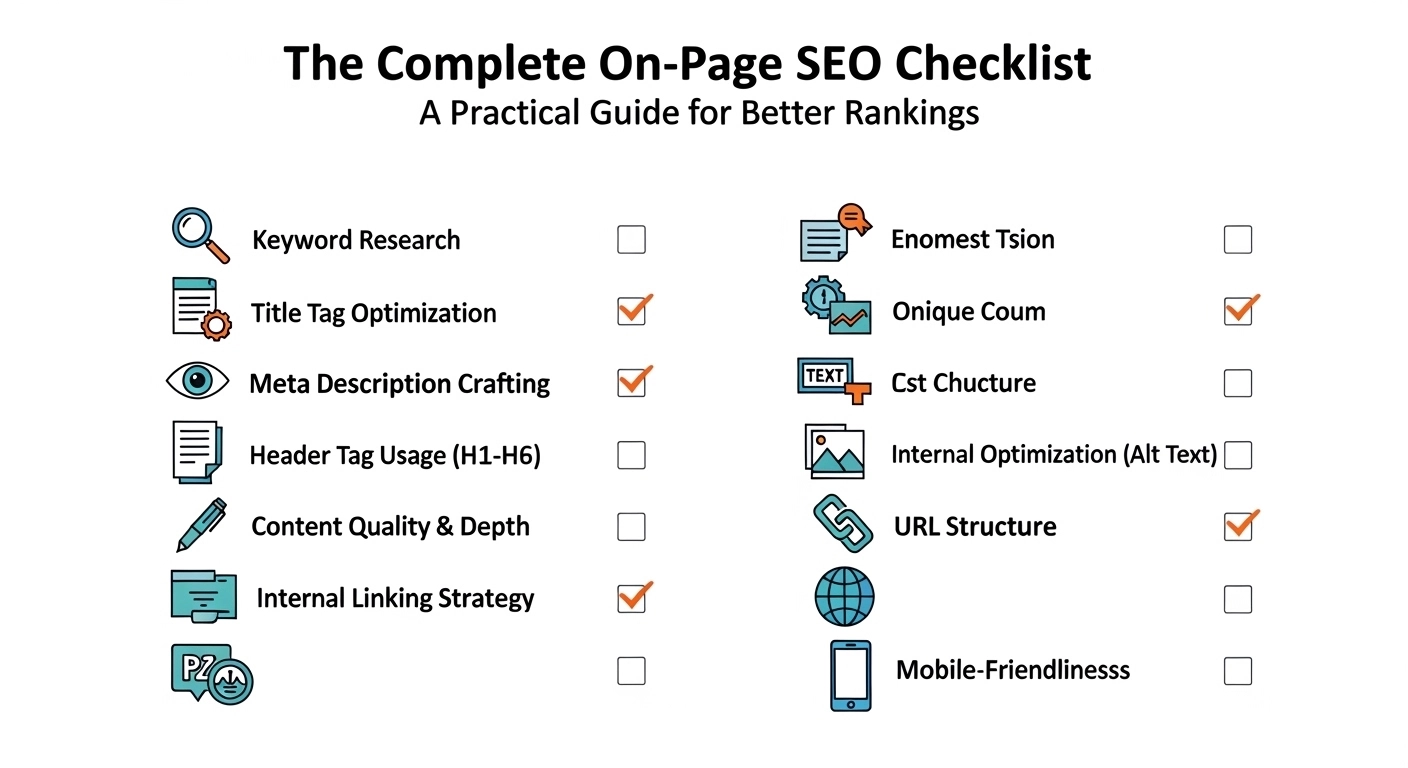
If you want your website to rank higher and attract consistent organic traffic, mastering on-page SEO is non-negotiable. While off-page factors like backlinks matter, what you control directly on your website often makes the biggest difference—especially in the early stages.
On-page SEO is all about optimizing individual pages so that search engines understand your content and users find it valuable. When done correctly, it improves visibility, user experience, and ultimately conversions.
This guide gives you a complete, actionable on-page SEO checklist—covering everything from content and keywords to technical elements and user experience. Whether you’re a beginner or looking to refine your strategy, this article is designed to be your go-to reference.
Quick Answer: What Is an On-Page SEO Checklist?
An on-page SEO checklist is a structured list of optimization tasks you apply directly to your website pages. It ensures that your content is well-organized, relevant, technically sound, and user-friendly, helping search engines rank it higher.
At its core, it includes:
- Keyword optimization
- Content quality and structure
- Meta tags (title and description)
- URL structure
- Internal linking
- Image optimization
- Page speed and mobile usability
Now let’s break it down in detail.
Keyword Optimization: The Foundation
Find the Right Keywords
Everything starts with understanding what your audience is searching for. Focus on keywords that match user intent rather than just high search volume.
For example, instead of targeting “SEO,” a better keyword might be “on-page SEO checklist for beginners.”
Place Keywords Strategically
Once you have your target keyword, place it naturally in key areas:
- Title tag
- First 100 words
- Headings (especially H1 and H2)
- URL
- Meta description
- Image alt text
Avoid keyword stuffing. Your content should read naturally.
Use Variations and Related Terms
Search engines understand context. Include related phrases, synonyms, and variations to make your content more comprehensive.
Content Quality and Structure
Write for Humans First
High-quality content is the backbone of on-page SEO. Your content should:
- Answer the user’s query clearly
- Provide depth and value
- Be easy to read
Thin or generic content rarely ranks well.
Maintain Proper Content Structure
Use headings to organize your content logically:
- One main title (H1)
- Clear sections (H2)
- Subsections where needed (H3)
This improves readability and helps search engines understand your page.
Optimize Content Length
There’s no fixed word count, but longer, in-depth content tends to perform better—provided it stays relevant and useful.
Title Tags and Meta Descriptions
Craft a Strong Title Tag
Your title tag is one of the most important ranking factors. It should:
- Include your main keyword
- Be clear and compelling
- Stay within 50–60 characters
Example:
“On-Page SEO Checklist: 20 Steps to Optimize Your Website”
Write an Engaging Meta Description
Although not a direct ranking factor, it affects click-through rates.
A good meta description:
- Summarizes the content
- Includes the keyword
- Encourages users to click
Keep it around 150–160 characters.
URL Optimization
Keep URLs Clean and Simple
A good URL is short, readable, and descriptive.
Bad:example.com/p=12345
Good:example.com/on-page-seo-checklist
Include Keywords
Use your main keyword in the URL, but avoid stuffing or making it too long.
Header Tags (H1, H2, H3)
Use Only One H1 Tag
Your H1 should clearly define the topic of the page and include the primary keyword.
Use H2 and H3 for Structure
Break your content into sections using H2 and H3 tags. This improves readability and helps users scan your content easily.
Internal Linking
Link to Relevant Pages
Internal links help distribute authority across your site and guide users to related content.
For example, if you mention keyword research, link to a detailed guide on that topic.
Use Descriptive Anchor Text
Instead of “click here,” use meaningful text like “learn more about keyword research.”
Image Optimization
Use High-Quality Images
Images improve engagement, but they must be optimized.
Add Alt Text
Alt text helps search engines understand images and improves accessibility.
Example:
“on-page SEO checklist infographic”
Compress Images
Large images slow down your site. Use compression tools to keep file sizes small without losing quality.
Page Speed Optimization
Why Speed Matters
A slow website frustrates users and hurts rankings. Page speed is a critical ranking factor.
Improve Loading Time
- Optimize images
- Use caching
- Minimize code (CSS, JavaScript)
- Choose a fast hosting provider
Even a one-second delay can impact conversions.
Mobile-Friendliness
Optimize for Mobile Devices
Most users browse on mobile. Your website must:
- Be responsive
- Load quickly on mobile
- Have easy navigation
Google prioritizes mobile-first indexing, so this is essential.
User Experience (UX)
Make Navigation Simple
Users should find what they need quickly. Clear menus and logical structure improve engagement.
Reduce Bounce Rate
Engaging content, fast load times, and good design keep users on your site longer.
Improve Readability
- Use short paragraphs
- Add spacing
- Use headings
- Avoid complex sentences
Technical Elements You Shouldn’t Ignore
Use Schema Markup
Structured data helps search engines understand your content better and can improve how your page appears in search results.
Optimize for Featured Snippets
Answer questions clearly and concisely. Use structured formats where possible.
Fix Broken Links
Broken links hurt user experience and credibility. Regularly audit your site.
Important Points People Often Overlook
Many people focus only on keywords and content but ignore these critical elements:
- Consistent formatting across pages
- Updating old content regularly
- Proper use of canonical tags
- Avoiding duplicate content
- Using HTTPS for security
These factors quietly influence performance and trust.
Common Mistakes to Avoid
Keyword Stuffing
Overusing keywords makes content unnatural and can lead to penalties.
Ignoring Search Intent
If your content doesn’t match what users want, it won’t rank—no matter how optimized it is.
Duplicate Content
Copying content from other pages or even within your site can harm rankings.
Poor Internal Linking
Not linking related pages reduces your site’s overall effectiveness.
Neglecting Mobile Optimization
A site that doesn’t work well on mobile will struggle to perform.
Practical Tips and Best Practices
Focus on consistency. Apply the same optimization standards across all pages.
Update your content regularly to keep it fresh and relevant.
Use analytics tools to track performance and identify what works.
Always prioritize the user. If your content genuinely helps people, rankings will follow.
Test different titles and descriptions to improve click-through rates.
FAQs
What is the most important factor in on-page SEO?
Content quality is the most important factor. If your content doesn’t provide value, no amount of optimization will make it rank well.
How often should I update my pages?
You should review and update important pages every few months to keep them relevant and accurate.
Can I rank without backlinks using on-page SEO?
Yes, especially for low-competition keywords. Strong on-page optimization can help you rank even without many backlinks.
How long does it take to see results?
It usually takes a few weeks to a few months, depending on competition and consistency.
Is on-page SEO enough for long-term growth?
On-page SEO is essential, but combining it with off-page strategies leads to better and more sustainable results.
Conclusion
A well-executed on-page SEO checklist is one of the most powerful tools you have to improve your website’s performance. It gives structure to your efforts, ensures nothing is overlooked, and helps you build a strong foundation for long-term success.
By focusing on high-quality content, proper keyword usage, technical optimization, and user experience, you create pages that both search engines and users appreciate.
Treat this checklist not as a one-time task, but as an ongoing process. The more consistently you apply these principles, the better your results will be over time.
